Alternative title:- Serendipity rules, O.K.
This post is not about an obese Polish person who has a huge appetite, lives alone and has to be fed anally. I know a hilarious suppository joke, but it's not really suitable for this blog.
Having stayed up all night reading nearly 800 comments on Jack Kruse: Neurosurgeon. Leptin Reset and Cold Thermogenesis. Controversy, I noticed Sean's comment about Antennas.
I designed antennas for 225MHz to 400MHz portable man-pack radios (also a 1GHz to 3GHz Ultra Wide Band monopole antenna). There were two existing man-pack antennas, affectionately known as "The Bird-cage" and "The Egg-whisk". Electrically they worked well, but they would both catch in branches when the radio was used in woods.
My mission (should I choose to accept it, which I did) was to design an antenna that had a good impedance match over 225MHz to 400MHz, a good gain and couldn't get caught in branches.
The reason why the original antennas were shaped like bird-cages and egg-whisks was because barrels and inverse cones give a better impedance match than a piece of wire. Don't ask me why. The answer is extremely complicated and even I don't understand it!
The antenna had to be a bottom-fed monopole (an antenna which is designed to work with a ground-plane) with a connector at the bottom which plugged into the radio's RF connector. The RF system impedance was the standard 50 ohms.
As fat cylinders give a better impedance match than thin cylinders (a wire being an extreme case of a thin cylinder), I went for the fattest cylinder that would be acceptable on a man-pack radio. I designed an impedance-matching transformer using one of THESE made out of THIS. I connected the transformer to the end of the fat cylinder and examined the impedance using a 8753C Network Analyzer (or even older model).
During some faffing-about, a wire snapped and I was amazed to see that the match to 50 ohms improved. This led to other improvements being made, resulting in the Capacitive Bottom-fed Fat Monopole. It was rugged, it couldn't get caught in branches and it had a high gain. You could even bash somebody over the head with it without breaking it. It worked well on field trials. There were two versions - a short one for covert use which had a lower gain and a longer one for normal use which had a higher gain.
I hope you found that interesting. It's nice (for me) to blog about stuff that I have qualifications in!
Tampilkan postingan dengan label Radio waves. Tampilkan semua postingan
Tampilkan postingan dengan label Radio waves. Tampilkan semua postingan
Sabtu, 07 April 2012

Rabu, 28 Maret 2012
Smart meters.
I was chatting to Kerrie's mum the other day and she was worrying about Smart meters. These are utility (usually electric) meters that can communicate their readings via radio waves & the internet to the utility companies to allow them better control of their generation plant. She'd been surfing the internet and had found sites warning about cancer and other health problems caused by the radiation from Smart meters. These sites are creating fear, uncertainty and doubt in order to sell solutions to problems that don't exist. Oh, dear.
Warning! Radio Frequency (RF) engineering stuff:-
See the graph below?
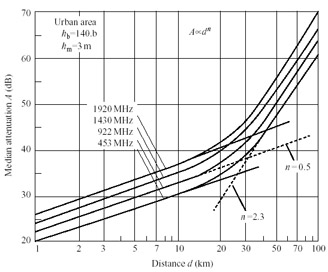
The horizontal axis is incorrectly labelled. Distance (d) is in metres (m), not kilometres (km).
Trust me. I know what I'm talking about. I was an RF design engineer for 29 years. See my CV.
The vertical axis is path attenuation (loss) in decibels (dB).
Decibels 101: Power loss in dB = 10 x LOG10 of the loss as a fraction.
A power loss of down to One tenth = 10dB. One hundredth = 20dB. One thousandth = 30dB. One millionth = 60dB. One million millionth = 120dB. One half = 3dB. One quarter = 6dB. One eighth = 9dB. Got it?
Smart meters transmit at frequencies from 900MHz (Vodafone & O2) to 1.9GHz (Orange & T-mobile etc). I mentioned mobile phone networks, as people don't seem to mind having mobile phones glued to their ears for long periods of time.
If you stand 4 metres away (at the end of someone's garden path, say) from a Smart meter fitted to their house & operating at 900MHz, there's a path loss of 29dB. The RF energy reaching you is 1/800th of that emitted by the meter. Also, the meter doesn't produce RF energy all of the time. The duty cycle is 1% to 5% i.e. RF energy is only produced for 1/100th to 1/20th of the time.
In conclusion, even if you stand with your nose touching the glass window of a Smart meter, you get less RF radiation (RF radiation is Transverse Electromagnetic Radiation a.k.a. radio waves and not ionising radiation as from radioactive materials) than from your mobile phone.
Are you feeling reassured, now? My work here is done!
Warning! Radio Frequency (RF) engineering stuff:-
See the graph below?
The horizontal axis is incorrectly labelled. Distance (d) is in metres (m), not kilometres (km).
Trust me. I know what I'm talking about. I was an RF design engineer for 29 years. See my CV.
The vertical axis is path attenuation (loss) in decibels (dB).
Decibels 101: Power loss in dB = 10 x LOG10 of the loss as a fraction.
A power loss of down to One tenth = 10dB. One hundredth = 20dB. One thousandth = 30dB. One millionth = 60dB. One million millionth = 120dB. One half = 3dB. One quarter = 6dB. One eighth = 9dB. Got it?
Smart meters transmit at frequencies from 900MHz (Vodafone & O2) to 1.9GHz (Orange & T-mobile etc). I mentioned mobile phone networks, as people don't seem to mind having mobile phones glued to their ears for long periods of time.
If you stand 4 metres away (at the end of someone's garden path, say) from a Smart meter fitted to their house & operating at 900MHz, there's a path loss of 29dB. The RF energy reaching you is 1/800th of that emitted by the meter. Also, the meter doesn't produce RF energy all of the time. The duty cycle is 1% to 5% i.e. RF energy is only produced for 1/100th to 1/20th of the time.
In conclusion, even if you stand with your nose touching the glass window of a Smart meter, you get less RF radiation (RF radiation is Transverse Electromagnetic Radiation a.k.a. radio waves and not ionising radiation as from radioactive materials) than from your mobile phone.
Are you feeling reassured, now? My work here is done!
Langganan:
Postingan (Atom)