Tampilkan postingan dengan label False dichotomy. Tampilkan semua postingan

Senin, 26 Agustus 2013

False dichotomies: serum cholesterol level vs all-cause mortality. Cause or effect?

Here are some plots from the MRFIT study.
From http://sph.bu.edu/otlt/MPH-Modules/PH/PH709_Heart/PH709_Heart5.html

Although the relative risk (RR) for coronary heart disease (CHD) and cardiovascular disease (CVD) mortalities increase with serum total cholesterol (TC) level, all-cause mortality follows a U-curve.

According to Low Serum Cholesterol and Mortality: Which Is the Cause and Which Is the Effect?, certain illnesses that increase mortality lower TC levels. This is the Iribarren hypothesis.

According to Cholesterol and all-cause mortality in elderly people from the Honolulu Heart Program: a cohort study, TC that's low and is still low 20 years later results in a 64% increase in the RR for mortality relative to TC that's intermediate and is still intermediate 20 years later.

Table 4 Relative risk for mortality based on change in cholesterol between examinations three and four
Is low TC level the cause of, or the effect of fatal illnesses? I think that it's both. Cholesterol is an important substance, as a severe lack of it is bad news, as per Smith–Lemli–Opitz syndrome. If certain illnesses result in a depletion of cholesterol and cholesterol synthesis is too low, there's insufficient cholesterol to allow recovery.

Interestingly, TC that's low but is intermediate 20 years later results in a 30% increase in the RR for mortality, whereas TC that's low but is high 20 years later results in a 5% increase in the RR for mortality.

P.S. There's a false dichotomy for vitamin D level vs illness. Ditto for carbohydrates vs calories.

Jumat, 16 Agustus 2013

False dichotomies: moderation.

Feel like you're walking a tightrope? I sang this at Open Mic night on Wednesday, including the orchestration!


There's another internet "punch-up" over moderation in what people eat. Apparently, there are only two options:-

Everything in moderation,
Image from http://www.deltadentalarblog.com/2013/07/ditch-the-junk-help-your-kids-eat-better/
or Nothing in moderation.

As always, it's a case of "It all depends". If, when you're at home, you keep raiding the chocolates from the box or sweets/candies from the tin and you don't want to, don't have them in the house. However, if when you're not at home, someone offers you a chocolate or a small sweet/candy, unless you're so desperate that you'll steal some more or go to a shop and buy some more, eat the chocolate or small sweet/candy. Five grams of sugar won't harm you, even if you're diabetic.

If you have Coeliac Disease and mustn't eat any significant gluten, moderation isn't an option. Ditto, if you have impaired gut integrity and you feel better avoiding gluten. If consuming stuff doesn't cause you medical problems or make you desperate to consume even more, moderation is fine.

EDIT: Sometimes, I ramble in a way that makes it hard for people to understand what I'm talking about. I've emphasised the word "Apparently", as this post is about a perceived false dichotomy (perceived by the "Nothing in moderation" group).

Kamis, 11 Juli 2013

Diet, Nutrition & Fitness: Whatever the question, the right answer is "It all depends".

The carbohydrate pendulum keeps on swinging! Bloggers keep on fighting!
Carbohydrates are good. No, they're bad. Wait, they're good again. Nope, bad again. Good again. Aargh!
So, are carbohydrates good or bad? See the title. Gluten? See the title.

As Everyone is Different, whether "X" is good, bad or indifferent all depends on genes (including gender), the expression of those genes, environment (i.e. birth weight, exposure to pollutants in the womb & after birth), general diet (i.e. nutrients, anutrients & anti-nutrients), lifestyle (i.e. sunlight exposure, stress, sleep etc) and type, level & volume of activity.

Senin, 07 Februari 2011

False dichotomies: Good or Bad?

The false dichotomy a.k.a. false dilemma is an example of black and white thinking i.e. everything is either "good" or "bad" with no shades of grey in-between.

On a popular body-building forum that I post on, I often see posts titled "Is *insert name of food here* good or bad?" I would like to grab the poster by the collar and give him/her a good shake, except that they are almost certainly bigger & stronger than I am and would "Smash me in" (an in-joke on that forum).

I've noticed the same effect elsewhere on the internet where certain things are deemed to be good (e.g. meat from grass-fed animals) or bad (e.g. omega-6 pufas). With man-made trans-fats, there's little doubt. They're bad!

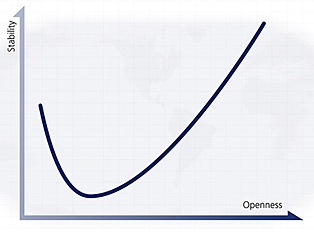
Consider the following curve.


Just about everything food-related follows a J-curve, with amount on the horizontal axis and harm on the vertical axis.

Too little results in starvation/deficiency and too much results in obesity/toxicity. Even dietary carbohydrate can follow a J-curve. See Dangers of Zero-Carb Diets, I: Can There Be a Carbohydrate Deficiency? and Dangers of Zero-Carb Diets, II: Mucus Deficiency and Gastrointestinal Cancers.

The other problem with "good" & "bad" is down to human nature. People think that if "healthy fats" are good, then eating 10 times as much "healthy fats" is better. They also think that if too much sun exposure is bad, then zero sun exposure is better.

Like Goldilocks' porridge, there is a "just right" for everything. See Hormesis.