This is a guest post from Coach Nick Tumminello has built a reputation as the ‘Trainer of trainers” through his workshops at conferences and fitness club around the world. And, for his consulting work with pro/college sports teams and with exercise equipment/ clothing manufactures.
He’s the owner of Performance University international, which provides hybrid strength training & conditioning for athletes and educational programs for fitness professionals. Based in South Florida, Nick is a Fort Lauderdale personal trainer who works with a select group of athletes and exercise enthusiasts.
You can check out Coach Nick’s articles, DVDs, seminars schedule, mentorship program and very popular hybrid fitness training blog at http://nicktumminello.com/
7 Psychological Reasons Why Experts will always argue; Training Debates are a waste; and the Fitness industry will stay divided.
I often get asked why I don’t express my feelings about what other coaches are doing/saying, or why I no longer get involved in training debates with other coaches or on the fitness forums? My answer is always the same: “Because I now have a better understanding of human psychology.” I then follow that answer with this advice, “if you’re asking me this because you’re hoping for someone to actually “win” one of these training arguments so you can finally have an answer. Or, you’re thinking that any of these highly debated training topics will soon reach a generally agreed upon consensus – get ready to die as a very confused and frustrated trainer… because those training arguments aren’t even about training to begin with. That’s why no one ever seems to change their mind even when their views are eroded by science. These debates aren’t about information, they’re about the mind games we’ve all played on ourselves and we don’t even know it.”
Turning A Negative into a Positive!
I know all this is sounding awfully negative. And, negativity just ain’t my style. But, this post isn’t about my usual innovative, solutions-based hybrid training concepts. Instead, it’s about 7 Psychological facts, which are an unavoidable part of human nature that, although negative in nature, we all must accept and work to better understand.
That said, the positive outcome is that becoming aware of and learning to embrace these factors has really helped me to better understand myself, my clients, my fellow colleques; and helped to to better maximize my time and mental energy in a more productive manner. And, I know they’ll do the same for you too. That is, if you’re willing to first embrace and address them within yourself before everyone else.
You’re about to discover why one of my favorite old punk-rock bands: The Descendents, were right on (back in the early 90s) with what they say in the beginning of their classic punk song Cool To Be You - “I don’t believe in unity. It’s just one more abandoned dream. Once the people get together it’s easy to see. It’s just a matter of time before they come after me.”
Why Arguments About Training have Little to Do With Training
Think about it! Have you ever seen a forum of facebook debate about training where one coach said “you know what, you’re right and I’m wrong – I’ll do it your way from now on.” Usually if something like that is said, its more likely said in a passive aggressive style because one person simply got sick of arguing.
Have you also noticed that in these debates people assume a great deal, often filling in the blanks and putting words in each other’s mouths? Or, coaches often seem to take the same rebuttal stance regardless of the challenging information that gets posed to them? Better yet, have you seen how trainers often take it personally and get all defensive when you simply show them scientific evidence that may have found results, which challenge they’re views, as if you just trash-talked their mother. I could go on, but you get the point!
The fact is, in theses coaches vs. coaches debates, both parties can present logical, rational and even scientifically backed evidence in favor of their thought process. Yet, often times, all involved end up calling the other “stupid” or accuse one another of using “flawed logic” and seem to end up personally not liking one another simply because they have different professional outlooks. How can this be?
How can so many passionate and motivated fitness professionals who all incorporate both science and common sense, and who all have success still remain so separated and at opposite sides of the track?
These 7 Psychological Facts will explain why these on-going intra-industry issues have little (if anything) to with how we train. Instead, they have to do with how we think.
1. Ad Hominem

According to David McRaney, author of You Are Not So Smart, “It’s a misconception that if you don’t trust someone, you should ignore their claims. The Truth is: What people say and why they say it should be judged separately.” - “This knowledge is is based on the Ad Hominem fallacy. It comes into play when you judge people based on who they are, not what they have to say.” – “An Ad Hominem attack occurs when you criticize the person rather then their claims. It happens when, in the midst of a heated discussion, someone points a finger and say “You’re stupid!.”
McRaney adds, “You see it in politics all the time. if you can’t taint the character of a person, it’s easy to taint whatever he’s bringing to the table.”
Fitness Industry Example of an Ad Hominem: My great friends Bret Contreras and Brad Schoenfeld recently wrote a research review paper called To Crunch or Not to Crunch, which most have probably read by now.
Brad and Bret did not actually conduct any of the studies they provided in their paper. All they did in their paper was review the related scientific evidence and provide simple recommendations based on the science. But, those who felt the paper refuted their personal beliefs & biases fought back by taking personal pot-shots at Bret and Brad themselves… while basically ignoring the actual scientific evidence they provided.
When all you do is look at the people who simply put the information in one place for us to read, instead of looking at the information itself, it insults the researchers who actually did perform the studies. And, it directly undermines the scientific information gained from theses studies.
Heck, after the paper came out all you heard was Contreras vs. McGill. It wasn’t about information, it was about people. Then of course coaches said, I’ll go with McGill because Bret is younger and less experienced. That my friends is a glaring example of an Ad Hominem fallacy.
Judge the information for only what it is: INFORMATION… NOT the person or people providing it!
2. Illusory superiority
The generally used definition of Illusory superiority is a cognitive bias that causes people to overestimate their positive qualities and abilities and to underestimate their negative qualities, relative to others.

You may have heard the quote, “The average person thinks they aren’t.” Well, the science proves that to be true!
In a survey done at the University of Nebraska, 68% of the faculty rated themselves in the top 25% for teaching ability.(1)
In a another similar survey done at Stanford University, 87% of MBA students rated their academic performance as above the median. (2)
Paul C. Price, author of the paper Are You as Good a Teacher as You Think?, did a great job of describing why teachers and coaches should understand Illusory superiority: ”Unfortunately, the most appropriate reaction—concern—is also the least likely, because people’s tendency to think of themselves as better than average extends to their ability to avoid such biases; “Sure other people overestimate their traits and abilities, but I would never do that.” See the problem? Concern is appropriate, however, because there is a great deal of evidence from social-cognitive psychology that pretty much anyone who isn’t clinically depressed systematically overestimates his or her own traits and abilities in a wide variety of domains. Furthermore, the nature of teaching makes it especially prone to such overestimation for reasons that I describe in this paper. A second reason that we, as teachers, should be concerned by this result is that recognizing our shortcomings is a prerequisite for improvement and, perhaps surprisingly, can be tremendously motivating.”
Fitness Industry Example of Illusionary Superiority: We all know that controversy gets attention. Well, there are two reasons one would create controversy: to get attention, or to provide new information that shows us we may need to change.
You’ll find the same coaches who accuse other trainers of creating controversy simply to get attention, are the very same ones who’ve created controversy themselves. That’s because they obviously believe that THEY caused a stir because they were smart enough to realize something everyone else had yet to uncover and they simply wanted to enlighten the rest of us. But, to them anyone else who challenges current beliefs has devious intentions because they’re not smart enough to find something the rest of us have yet to see. That is a great example of Illusionary superiority.
Note: The next 2 Psychological Factors on my list below are actually the two (out of 5) main mechanisms proposed by Alicke and Govorun (2005) (3), in attempt to explain why illusory superiority (which they refer to as the better-than-average effect) occurs. (The info for #3 & 4 has been taken directly from this Wikipedia page.)
3. Selective recruitment

This is the idea that when making a comparison with a peer an individual will select their own strengths and the other’s weaknesses in order that they appear better on the whole.
Perloff and Fetzer (1986) suggested that when comparing themselves to an average peer on a particular ability or characteristic an individual would choose a comparison target (the peer being compared) that scored less well on that ability or characteristic, in order that the individual would appear to be better than average.
However these results are not completely reliable and could be affected by the fact that individuals like their close friends more than an “average peer” and may as a result rate their friend as being higher than average, therefore the friend would not be an objective comparison target.(4)
Fitness Industry Example of Selective recruitment: There are some many different training styles and systems in our industry. All of which have their strengths and weaknesses. Yet, many of the zealot members of these systems argue why THIER way is best and why their fellow members of the group “get it”, while others don’t. They like to bring to light the strengths of their system while focusing on the limitations of other’s systems.
4. Egocentrism
This is the idea that an individual places greater importance and significance on their own abilities, characteristics and behaviors than those of others. Egocentrism is therefore a less overtly self-serving bias.

According to egocentrism, individuals will overestimate themselves in relation to others because they believe that they have an advantage that others do not have, as an individual considering their own performance and another’s performance will consider their performance to be better, even when they are in fact equal. Kruger (1999) (5)
Fitness Industry Example of egocentrism: Have you ever met a yoga instructor who has told you that you DON’T need yoga. How about a powerlifter who said that you were already strong enough. Or, a corrective specialist that told you that your posture was fine and that you had zero muscle imbalances or asymmetries? Or course not! That’s egocentrism at work!
Another example is that coaches often down other (younger) coaches of whom have less experience than they do. Interestingly, 5yr coaches say 2-3yr coaches don’t have enough experience. The 10yr veterans say the 5yr coaches aren’t experienced enough. The 20yr coaches say…
It always seems to be the # of years experience YOU have is the “optimal #” of experience. And, isn’t it funny that when someone has been in the game for a very longtime, much longer than us, we just call them a “dinosaur” who’s stuck doing things the “old” way.
5. Humans are Tribal oriented!

Just look at politics and you’ll see glaringly obvious example of how us humans are tribal oriented creatures. Put simply, we like to bond with like-minded folks. And, we like to make fun of the people (in other tribes) who don’t think like us.
The fitness training world is just like the political world. In that, we have the Kettlebell party (and various divisions of that), the Pilates Party, the Yoga Party, the Strength Party (and various division of that like bodybuilding, powerlifting, strongman), the corrective exercise (aka., wanna be PTs), the functional 3D training party, and so on.
Within these parties we have moderates and we also have the extremists, who’ve pledged their allegiance to their chosen style or system.
Now, we all know nothing ever gets agreed upon in politics. Although we all have the same goals, which is to solve problems, the politics of fitness seem to prevent us from agreeing on the appropriate solutions.
Plus, it doesn’t help that the extremists continually cultivate a gang-like environment, and always seem ready to wage war to “prove” their way is “the right way”.
6. Conforming to the Norm

Studies shows that many of us will deny our own senses just to conform with others. (the below is taken directly from this post from PSYBlog)
“We all know that humans are natural born conformers – we copy each other’s dress sense, ways of talking and attitudes, often without a second thought. But exactly how far does this conformity go? Do you think it is possible you would deny unambiguous information from your own senses just to conform with other people?
Have a look at the figure below. Compare the line on the left with the three lines on the right: A, B & C. Which of these three lines is the same length as the lonesome line on the left?
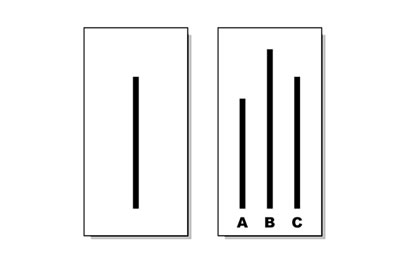
The results were fascinating, and not at all what you’d expect:
- 50% of people gave the same wrong answer as the others on more than half of the trials.
- Only 25% of participants refused to be swayed by the majority’s blatantly false judgement on all of the 12 trials.
- 5% always conformed with the majority incorrect opinion (we all know people like that, right?!)
- Over all the trials the average conformity rate was 33%.
- All felt anxious, feared disapproval from others and became self-conscious.
- Most explained they saw the lines differently to the group but then felt the group was correct.
- Some said they went along with the group to avoid standing out, although they knew the group was wrong.
- A small number of people actually said they saw the lines in the same way as the group.
7. Confirmation Bias
“Confirmation bias refers to a type of selective thinking whereby one tends to notice and to look for what confirms one’s beliefs, and to ignore, not look for, or undervalue the relevance of what contradicts one’s beliefs. For example, if you believe that during a full moon there is an increase in admissions to the emergency room where you work, you will take notice of admissions during a full moon, but be inattentive to the moon when admissions occur during other nights of the month. A tendency to do this over time unjustifiably strengthens your belief in the relationship between the full moon and accidents and other lunar effects.” (taken directly from this post at Skepdic.com)

Another great explanation for Confirmation Bias comes from Paul Ingram, who’s website I really enjoy reading – “Confirmation bias explains a lot about human nature. Most people know it best as “selective hearing” or “selective memory” — hearing and remembering only what you want to hear. Confirmation bias is a whole lot more: a dazzling array of devious and largely unconscious mental tactics and thinking glitches that lead people to confirm their beliefs and pet theories. We not only tend to ignore, deny and overlook anything that contradicts our point of view, but we also invariably notice, inflate and or even fabricate anything that supports it. Confirmation bias is one of the main reasons that The Truth is so slippery, and both amateurs and experts alike are prone to significant thinking errors. There are people who strive to eliminate confirmation bias from their thinking — the best scientists and journalists, for instance — but it’s really difficult. Everyone has confirmation bias: it’s just how minds (don’t) work!”
Lessons & Take away for Fitness Pros
- The above Psychological factors make us ALL a little full of BS Yes, even YOU, ME, and your favorite leaders, experts, gurus, teachers, etc.
- When coming to judgements and conclusions, first look inward at yourself and ask yourself WHY you came to this conclusion. Ask yourself what are the counter arguments? And, ask yourself HOW you came to this conclusion? Is it based on emotion, science, following a leader…
- We all have strong beliefs in our training philosophies, which is great because it shows we’re passionate. But, we can’t fool ourselves into believing that we’ve put more thought into what we do than anyone else has, whether they agree with us or disagree.
- We must embrace our differences, have the discipline to accept our own weaknesses, and understand that we are only half as smart as we’ve tricked ourselves into believing we are.
- Understand that when we feel someone needs to “learn more” or “use better logic/ common sense”, they’re most likely thinking the exact same thing about us!
- Accept that we’re probably not as special as our moms told us we were.
- Understand that arguing about fitness training and trying to prove why your way is best is probably not the best use of your time and mental energy, unless you like to be frustrated and/or hear yourself talk.
- Rarely will training subjects reach a generally accepted expert consensus. So, waiting for one will keep you lost and confused. To get answers, we must take things into our own hands by searching for our own truth, which involves using our own better-judgement, common sense and scientific knowledge.
You’ll never be Right!
We all must choose whether we’d rather work to be “effective” or try to be “right.” I choose to be effective! And, understanding the 7 Psychological realities I’ve listed above have empowered me with knowledge to be a more effective learner and teacher. I hope you’re able to use this knowledge to do the same for you!
References
1. Cross, P. (1977). “Not can but will college teachers be improved?”. New Directions for Higher Education 17: 1–15.
2. “It’s Academic.” 2000. Stanford GSB Reporter, April 24, pp.14–5. viaZuckerman, Ezra W.; John T. Jost (2001). “What Makes You Think You’re So Popular? Self Evaluation Maintenance and the Subjective Side of the “Friendship Paradox”". Social Psychology Quarterly (American Sociological Association) 64 (3): 207–223. doi:10.2307/3090112.JSTOR 3090112. Retrieved 2009-08-29.
3. Alicke, Mark D.; Olesya Govorun (2005). “The Better-Than-Average Effect”. In Mark D. Alicke, David A. Dunning, Joachim I. Krueger. The Self in Social Judgment. Studies in Self and Identity. Psychology Press. pp. 85–106. ISBN 9781841694184. OCLC 58054791.
4. Perloff, L.S.; B.K. Fetzer (1986). “Self-other judgments and perceived vulnerability to victimization”. Journal of Personality and Social Psychology(American Psychological Association) 50 (3): 502–510. doi:10.1037/0022-3514.50.3.502
5. Kruger, J. (1999). “Lake Woebegon be gone! The “below-average effect” and the egocentric nature of comparative ability judgments”. Journal of Personality and Social Psychology 77 (2): 221–232. doi:10.1037/0022-3514.77.2.221. PMID 10474208
6. A study of normative and informational social influences upon individual judgment.Deutsch, Morton; Gerard, Harold B. The Journal of Abnormal and Social Psychology, Vol 51(3), Nov 1955, 629-636.