Senin, 07 Februari 2011

False dichotomies: Good or Bad?

The false dichotomy a.k.a. false dilemma is an example of black and white thinking i.e. everything is either "good" or "bad" with no shades of grey in-between.

On a popular body-building forum that I post on, I often see posts titled "Is *insert name of food here* good or bad?" I would like to grab the poster by the collar and give him/her a good shake, except that they are almost certainly bigger & stronger than I am and would "Smash me in" (an in-joke on that forum).

I've noticed the same effect elsewhere on the internet where certain things are deemed to be good (e.g. meat from grass-fed animals) or bad (e.g. omega-6 pufas). With man-made trans-fats, there's little doubt. They're bad!

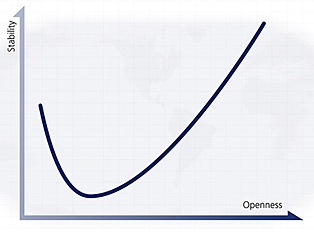
Consider the following curve.


Just about everything food-related follows a J-curve, with amount on the horizontal axis and harm on the vertical axis.

Too little results in starvation/deficiency and too much results in obesity/toxicity. Even dietary carbohydrate can follow a J-curve. See Dangers of Zero-Carb Diets, I: Can There Be a Carbohydrate Deficiency? and Dangers of Zero-Carb Diets, II: Mucus Deficiency and Gastrointestinal Cancers.

The other problem with "good" & "bad" is down to human nature. People think that if "healthy fats" are good, then eating 10 times as much "healthy fats" is better. They also think that if too much sun exposure is bad, then zero sun exposure is better.

Like Goldilocks' porridge, there is a "just right" for everything. See Hormesis.

Minggu, 06 Februari 2011

Comments Enabled.

Any resemblance to a post by another blogger is completely intentional.

I like to think that this blog functions a bit like Wikipedia. Each post is peppered with hyperlinks.

I post music videos, as they add variety to what is otherwise a rather dry subject. I also post pictures, as they both make my blog stand out on listing sites like Paleobuzz.

A blog is not a book. Once a book is published, it becomes outdated as soon as new information appears. A blog is easily edited. Therefore, when I learn something new that makes the information in a blog post outdated, I edit the post to bring the information up-to-date.

So please use this blog as if it was Wikipedia - continually updated for accuracy.

I also pepper my posts with references, hyperlinked for your convenience. I am retired, so I have more free time on my hands than someone who is working full-time. However, I don't spend many hours typing my posts as I hate writing. I have other things to do!

I will never write a book. The e-book that I wrote in 2005 was a brain-dump and it's now completely outdated.

I don't mind writing blog posts. I also don't mind spending a little extra time compiling references and creating links. I will stop blogging when I'm either depressed, incapable, dead or have run out of ideas (whichever happens first).

I will never disable comments. However, comments will always be moderated for new commenters and I will only approve comments that are free from:- insults, swearing, links to sales pages, long rambles, pointless arguments etc. I learn a lot from your comments, so keep 'em coming!

Finally, any e-mails sent to me that contain opinionated and/or poorly-researched rants may be published here (and will put you in the blocked senders list). I prefer to keep things public. I didn't expect the Spanish Inquisition!

Sabtu, 05 Februari 2011

It's all in a day's work (as measured in Joules)

The title is from the "Physics Man" sketch on The Now Show. Work is another word for energy and there are two different units for it.

The calorie (cal) is the amount of energy required to heat 1g of water by 1°C. This is a tiny amount of energy. The dietary Calorie (Cal) = 1,000cal = 1kcal.

The Joule (J) is the SI unit of energy. 1J = 1kg*m^2/s^2.
1Joule/sec = 1Watt (W).

1kcal = 4.186kJ.

At rest, an average human body uses ~1kcal/min = ~4,186J/min = ~69.8J/sec = ~69.8W.

The brain uses ~5g of glucose/hour = 18.75kcal/hour (1g of carb = 3.75kcals, usually rounded-up to 4) = 78487.5J/hour = ~21.8W.

The heart uses ~10W. The liver, kidneys, gut and lungs run continuously so they use energy all of the time.

Skeletal muscle uses a variable amount of energy using a variable proportion of fuels, depending on what you're doing with it. A chap called Steve sent me a spreadsheet of results in 2004 when he underwent a metabolic test on a stationary bike while breathing through a respiratory gas analyser, which calculated kcals burned and fuel usage by measuring Respiratory Exchange Ratio (RER).

At~1kcal/min (resting), he burned ~95% from fat (~0.11g/min), ~5% from carbs (~0.01g/min).
At 2kcal/min (12% max), he burned 100% from fat (0.22g/min), 0% from carbs (0.00g/min).
At 3kcal/min (18% max), he burned 100% from fat (0.33g/min), 0% from carbs (0.00g/min).
At 4kcal/min (24% max), he burned 99% from fat (0.44g/min), 1% from carbs (0.01g/min).
At 5kcal/min (29% max), he burned 48% from fat (0.27g/min), 52% from carbs (0.69g/min).
At 6kcal/min (35% max), he burned 62% from fat (0.41g/min), 38% from carbs (0.61g/min).
At 7kcal/min (41% max), he burned 58% from fat (0.45g/min), 42% from carbs (0.78g/min).
At 8kcal/min (47% max), he burned 46% from fat (0.41g/min), 54% from carbs (1.15g/min).
At 9kcal/min (53% max), he burned 42% from fat (0.53g/min), 58% from carbs (1.39g/min).
At 10kcal/min (59% max), he burned 44% from fat (0.49g/min), 56% from carbs (1.49g/min).
At 11kcal/min (65% max), he burned 38% from fat (0.46g/min), 62% from carbs (1.82g/min).
At 12kcal/min (71% max), he burned 41% from fat (0.55g/min), 59% from carbs (1.89g/min).
At 13kcal/min (76% max), he burned 37% from fat (0.53g/min), 63% from carbs (2.18g/min).
At 14kcal/min (82% max), he burned 30% from fat (0.47g/min), 70% from carbs (2.61g/min).
At 15kcal/min (88% max), he burned 14% from fat (0.23g/min), 86% from carbs (3.44g/min).
At 16kcal/min (94% max), he burned 0% from fat (0.00g/min), 100% from carbs (4.27g/min).
At 17kcal/min (100% max), he burned 0% from fat (0.00g/min), 100% from carbs (4.53g/min).

Over a wide range of intensities, the number of grams of fat Steve burned/min was fairly constant.

Note that 17kcals/min = 1186.6W, or 1.19kW. This level can be maintained for only a few seconds, as carbs are burned both aerobically and anaerobically, which exhausts PhosphoCreatine stores in muscles and also causes an accumulation of lactate in muscles. See Why do muscles hurt after exercise?

Muscle mass is very metabolically-active compared to fat mass, as one pound of fat mass burns only about 2kcal a day. See also Dissecting the Energy Needs of the Body – Research Review

Here's another Physics Man.

Jumat, 04 Februari 2011

Inflammation: Is omega-6 really to blame?

Take a look at the following diagram from Tripping Lightly Down the Prostaglandin Pathways showing the omega-6 and omega-3 pathways.


Omega-6 pufas result in the production of Series 1 prostaglandins (anti-inflammatory) and Series 2 prostaglandins (inflammatory). Omega-3 pufas result in the production of Series 3 prostaglandins (anti-inflammatory).

Now, see Are diets high in omega-6 polyunsaturated fatty acids unhealthy?

"Insulin sensitivity might be the common factor relating disease to fatty acid metabolism — both within and between the fatty acid pathways. A high linoleate to arachidonate concentration occurs in insulin resistance, in diabetic complications and also in some tumours."

"Current epidemiological and clinical evidence supports the regular consumption of cold-water fish as part of a balanced diet, in which attention to lifestyle and the quantities eaten (to prevent obesity and the insulin resistance syndrome) may be more critical than the nature of the fatty acids consumed."

Do you see where I'm going with this? If you have insulin resistance, don't change your diet (low in carbs & avoiding omega-6) to suit the insulin resistance. Tackle the insulin resistance!

This isn't an open invitation to start guzzling high-pufa oils. Stick to oils that have been squeezed out of things that grow in hot climates. I include Extra-Virgin Olive Oil in this category. Check the label, as the pufa contents of different EVOOs vary. Solesta from Aldi contains only 6.6% pufas.

EDIT: In addition, your brain depends on omega-3 to function properly. Too much omega-6 can "fry" it. See Mental Health and Omega 3/6 Ratio, A New Review.

Vitamin D is anti-inflammatory. Fish oils are also anti-inflammatory.


I just spotted this on Anthony Colpo's Blog: The Adventures of Chris “Razzi” Razwell and Other Assorted Internet Psychos. Oh, my!


And finally: I made mum a CD of "Dare" by The Human League (I bought it in vinyl years ago) and played it on the CD/Record player in the lounge at the nursing home. She loved it and was moving her arms in time with the music. This is her favourite track from that album.

Kamis, 03 Februari 2011

Move More: Solutions to problems.

Continued from Eat Less, Move More: Solutions to problems.

Firstly, here's "On the rebound" by Floyd Cramer. This was a hit in 1961 and it was recently used in a Sainsbury's "Taste the Difference" advert on TV.


Move More: Problems and their solutions:
1) Exercise makes me eat too much afterwards. Wrap up warm before you go outdoors, as feeling cold stimulates appetite.

2) Exercise is boring. Take a camera with you when you go for a walk. Look around. There's lots of interesting stuff out there that you don't normally notice*. Vary your route so that you see new things each time. Zumba is fun!

3) It's too cold/wet/windy etc. Dress appropriately. Have a small treat when you get back, so that you have something to look forward to.

4) I hate doing "x". Don't do "x", then. Things that I will not do are swimming & team sports (really bad memories from school-days). I also won't do anything faster than a power walk (being 72" tall with 31" legs makes any exercise involving my feet hitting the ground uncomfortable and hard on my joints).

5) I don't have the time. Neither do I. I'm now on-line less than I used to be. I'm sure I'll survive!

*I spotted a large photovoltaic solar panel on the roof of a house the other day. I knocked on the door and asked the occupants about it. Apparently, you get about 1kW from 10 square metres of panel and the Electricity supplier pays you about 43p for every kWh you generate. A 35 square metre system costs about £20,000.

When I realised that I had to get some exercise, it was a blow. Any news that is bad & inevitable takes some getting used to. See Kübler-Ross model. I have now accepted it.

Here's a school photo from when I was about 10.


Can you guess which one's me?

Any more problems & solutions that I haven't thought of?

Rabu, 02 Februari 2011

Insulin Resistance: Solutions to problems.

Before I start on what may be the most important thing that I've ever written, here's "Don't Stop Movin" by S Club 7. It's a clue to what's coming.


The problem:
Insulin Resistance (IR) is a major problem for a significant percentage of the population in the developed world. It can cause:-

High fasting serum glucose, which increases the risk factor for Coronary Heart Disease.
High post-prandial serum glucose, which increases the risk factor for Coronary Heart Disease, Retinopathy, Neuropathy & Nephropathy (Kidney failure) amongst other things.
High serum cholesterol.
High serum triglycerides, which in conjunction with high serum cholesterol increases the risk factor for Coronary Heart Disease.
High serum Free Fatty Acids (a.k.a. FFAs a.k.a. NEFAs) from IR fat cells, which increases the risk factor for Sudden cardiac death and also worsens IR in liver & muscle cells.
High serum uric acid, which increases the risk factor for Gout & urate Kidney stones.
Hypertension, which raises the risk factor for Coronary Heart Disease, Strokes & Kidney failure.
Excessive appetite after eating high-GL carbohydrates, due to rebound low serum blood glucose, leading to overeating & obesity.
Lethargy after eating almost anything, but especially after eating high-GL carbohydrates, due to compensatory hyperinsulinaemia.
If IR is left untreated, it can deteriorate into type 2 diabetes. See Type 2 diabetes in the UK.

The cause and solutions:
1) "Bad" genes. My genes aren't particularly good, but it is possible to change the expression of your genes.

2) Full cells. A full cell is an IR cell. Consider Liver, Muscle and Fat cells:-

a) Liver cells: Liver cells are a 2-way street. "Stuff" (e.g. NEFAs, Glucose & Fructose) goes in and "stuff" (e.g. Ketones & Glucose) comes out. Glucose normally comes out of the liver at a rate of ~5g/hour to fuel the brain, but this can increase a lot under the control of Insulin, Glucagon & Cortisol. If more stuff goes in than comes out, liver glycogen stores fill up and vice-versa. When liver glycogen stores become full, liver cells down-regulate processes that produce liver glycogen e.g. hexokinase & Glu-T2 transporters. Liver cells effectively become IR to stop more stuff from going in.

However, fructose uses Glu-T5 transporters which are insulin-independent & fructokinase which has a high affinity for fructose, so fructose effectively "barges its way in" to the liver. This is why fructose is a problem for people who have permanently full liver glycogen stores.

b) Muscle cells: Muscle cells are a 1-way street as far as Glucose is concerned, though Amino Acids can go in & come out. Muscle glycogen cannot be used to produce serum glucose - it can only be used by muscles. When muscle glycogen stores become full, muscle cells down-regulate processes that produce muscle glycogen e.g. hexokinase & Glu-T4 transporters. Muscle cells effectively become IR to stop more stuff from going in.

As per It's all in a day's work (as measured in Joules), muscle cells use mostly fat at rest & lowish-intensity exercise. Glycogen usage increases rapidly as exercise intensity increases. Now do you see the significance of the music video above? Intense exercise (e.g. Running, Sprinting, Resistance training with weights, parts of High-Intensity Interval Training a.k.a. HIIT, parts of Tabata & parts of Zumba) depletes your muscle cells and makes them Insulin Sensitive.

This means that exercise is compulsory. I have been in denial for years. Then, Uh-oh! There may be trouble ahead... happened. See Increased Glucose Transport–Phosphorylation and Muscle Glycogen Synthesis after Exercise Training in Insulin-Resistant Subjects and Improvement in Glucose Tolerance After 1 Wk of Exercise in Patients With Mild NIDDM (hat-tip to Go Kaleo). See also Move More: Solutions to problems.

However, don't overdo it! You may have a funny turn, keel over & hurt yourself. See "Funny turns": What they aren't and what they might be.

c) Fat cells: Fat cells are a 2-way street. Fat cells are a bit like balloons that are full of holes. As stuff (e.g. NEFAs & glucose) goes in, the balloon expands to accommodate it. As more stuff goes in and the balloon gets bigger, the internal pressure increases and the holes get bigger, so stuff (e.g. NEFAs & glycerol) comes out at a faster rate. At some level of fullness, stuff comes out as fast as it goes in. At that point, fat cells are effectively IR. So, don't overstuff your fat cells by getting too fat. If you are already too fat, medium intensity exercise (e.g. Walking, Power Walking, Jogging, "Aerobics", parts of High-Intensity Interval Training a.k.a. HIIT, parts of Tabata & parts of Zumba) depletes your fat cells and makes them Insulin Sensitive.

Dress appropriately so that you don't feel cold. Feeling cold is what stimulates your appetite, not exercise. See Influence of resistance and aerobic exercise on hunger, circulating levels of acylated ghrelin, and peptide YY in healthy males. I go for a 30 minute walk each evening.

3) Deficiency in Vitamin D3.
See Hypovitaminosis D is associated with insulin resistance and ß cell dysfunction.
The effects of calcium and vitamin D supplementation on blood glucose and markers of inflammation in nondiabetic adults.
The role of vitamin D and calcium in type 2 diabetes. A systematic review and meta-analysis.
A double-blind, randomized, placebo-controlled trial of the short-term effect of vitamin D3 supplementation on insulin sensitivity in apparently healthy, middle-aged, centrally obese men.
Plasma 25-hydroxyvitamin D concentration and metabolic syndrome among middle-aged and elderly Chinese individuals.
Vitamin D supplementation reduces insulin resistance in South Asian women living in New Zealand who are insulin resistant and vitamin D deficient - a randomised, placebo-controlled trial.

In January 2003, I had impaired Glucose Tolerance (fasting serum glucose = 6.8mmol/L & 2 hours post-75g glucose load serum glucose = 8.7mmol/L). A sandwich used to send me to sleep.

By September 2008, I had normal Glucose Tolerance (fasting serum glucose = 5.0mmol/L & 2 hours post-75g glucose load serum glucose = 3.7mmol/L). I also no longer suffered from hyperinsulinaemic drowsiness. I was also about the same weight that I was in 2003, so the improvement was not due to weight loss.

So, either use a UVB sun-lamp as per instructions to receive a sub-erythemal dose (not quite going pink) or get tested by your GP and supplement with Vitamin D3 accordingly. I take 5,000iu of Vitamin D3/day.

4) Deficiency in Magnesium.
For the top 999 foods highest in Magnesium per 100g serving, see HERE. I take ~4g of Epsom Salts/day (~400mg Mg/day). 

5) Deficiency in Vitamin K2.
See Vitamin K₂ prevents hyperglycemia and cancellous osteopenia in rats with streptozotocin-induced type 1 diabetes. Good sources of Vitamin K2 can be found HERE. I take a Vitacost Ultra Vitamin K with Advanced K2 Complex/day. Note: Warfarin/Coumadin works by depleting Vitamin K, so lots of Vitamin K2 makes Warfarin/Coumadin ineffective. 

6) Deficiency in Manganese. See Manganese supplementation protects against diet-induced diabetes in wild type mice by enhancing insulin secretion. For the top 999 foods highest in Manganese per 100g serving, see HERE.

7) Deficiency in, or excess of Copper w.r.t. Zinc. See Dietary copper supplementation restores β-cell function of Cohen diabetic rats: a link between mitochondrial function and glucose stimulated insulin secretion. For the top 468 foods highest in Copper per 100g serving, see HERE.

8) Deficiency in, or excess of Zinc w.r.t. Copper. See Zinc, pancreatic islet cell function and diabetes: new insights into an old story. For the top 999 foods highest in Zinc per 100g serving, see HERE.

9) Excessive intake of man-made trans-fats.
Base your diet on Real Food rather than manufactured food products.

10) Excessive intake of chemicals.
Don't swallow toothpaste (fluoride) or disclosing tablets (may contain iodine). Don't hold till receipts between your lips (may be coated in BPA). Don't slather too many chemicals on your skin.

Any other ideas for normalising insulin sensitivity?

Finally, the obligatory picture. Hannah Spearritt is rather nice. :-p


I nearly forgot! Today, when I arrived at mum's nursing home, I found her reading a book. She hasn't done that for over a year. She even knew that it was Wednesday. Ketogenic diet for the win. Mum now has a dual-fuel brain.
Selasa, 01 Februari 2011

Keep 'em tight.

Wheel nuts? Nope!
Image from http://suppversity.blogspot.de/2012/11/shedding-some-light-on-the-leaky-gut.html
I'm referring to Tight Junctions. As mentioned at the end of Wheat? Oh, dear! , 10% of the people who are healthy enough to donate blood have gut walls permeable enough to let gliadin fragments pass into the blood.

Tight junctions are important, as they keep the contents of the gut inside the gut and out of the blood. If you read Food Combining: What's THAT all about?, you'll see that during digestion, proteins are broken down into individual amino acids & very short peptide chains*. Amino acids & very short peptide chains are small enough to pass through tight junctions. Peptide chains longer than about 3 amino acids are too big to pass through. See also Physiology and Immunology of Digestion.

Carbohydrates are broken down into monosaccharides, which are small enough to pass through. Disaccharides are too large (except for Trehalose, which Jay Bryant told me about as a treatment for Alzheimer's Disease).

Fats are broken down into glycerol and fatty acids. Glycerol is small enough to pass through. Fatty acids and other fatty molecules such as Vitamin D, Co-enzyme Q10, Vitamin K2, curcumin, berberine etc are transported across.

The consequences of having loose junctions are not good. Stuff that's not supposed to get in to the blood gets in and stimulates the immune system to produce antibodies against it. That in itself is not a problem, unless the stuff that the body's produced antibodies against happens to resemble parts of your own body.

Diseases of autoimmune origin such as Coeliac disease (gut), Eczema (skin), Dermatitis herpetiformis (skin), Sjögren's syndrome (mucous membranes), Cerebellar ataxia (Purkinje cells in the brain), Multiple sclerosis (myelin sheaths of nerves), Type 1 Diabetes (pancreatic beta cells), Rheumatoid arthritis (joints), Asthma (lungs), Lupus erythematosus (various), Autoimmune thyroiditis (thyroid), LADA (pancreatic beta cells) etc are caused by the body's immune system mistakenly attacking the body. Autoimmune diseases can also occur after bacterial & viral infections.

The other day, I found Immune response to dietary proteins, gliadin and cerebellar peptides in children with autism.

See also Stronger Intestinal Barrier May Prevent Cancer in the Rest of the Body, New Study Suggests.

So, how do we keep 'em tight? See Vitamin D.
See also Dietary Fat Can Modulate Intestinal Tight Junction Integrity.
See also Shedding Some Light on the Leaky Gut <> Exercise Connection. Plus: 20+ Things You Should or Shouldn't Do to Protect and Restore the Integrity of Your Intestinal Wall.


In other news....
I had a phone call from mum's GP this morning. Having read my evidence, he's agreed to test mum's serum B12, 25(OH)D and Calcium and give her supplements accordingly. He's also happy with me giving mum a Ketogenic diet and will also advise the nursing home to exercise mum as often as she is able. Result!

I put four cubes of liver pâté out for Sooty & Sweep (I don't know which one is which as they're identical) and a Magpie swiped two of them. We also have seagulls. I put the other two cubes out of sight in a box.


So far, so good!

P.S. What fuel can be extracted from decomposing seagulls?
.
.
.
Wait for it...
.
.
.
Petrel! (From Petrol Direct, a joke site in case anyone's wondering).