What I also like is Kelly's effortless squat
Kamis, 29 Maret 2012

Rabu, 28 Maret 2012
Don't take it sitting down
I think we've heard this before now|:
Stand Up: Your Life Could Depend On It
Stand Up: Your Life Could Depend On It
ScienceDaily (Mar. 27, 2012) — Standing up more often may reduce your chances of dying within three years, even if you are already physically active, a study of more than 200,000 people published in Archives of Internal Medicine shows. The study found that adults who sat 11 or more hours per day had a 40% increased risk of dying in the next three years compared with those who sat for fewer than four hours a day. This was after taking into account their physical activity, weight and health status.
Good Science

Examine.com is a science-focused compendium on supplements, nutrition, fitness, and health. Akin to Wikipedia, we are a site that allows people to contribute to the site. Unlike Wikipedia, we have editors that oversee and approve all content.There is all sorts of stuff on there, well referenced and researched and well worth reading and referring to.
Movement Lectures - Good Listening.....
I just wanted to point to this new resource:

I am getting a bit bored with the podcasts that I have been listening to recently - I think that most things that can be said about paleo have now been said - so I was checking out these little mp3s
So far I've listened to Tim Anderson on crawling and Tom Furman on the ability to move. Both were really well produced, explained the topic well and came with a pdf transcript.
Good stuff.
I am getting a bit bored with the podcasts that I have been listening to recently - I think that most things that can be said about paleo have now been said - so I was checking out these little mp3s
So far I've listened to Tim Anderson on crawling and Tom Furman on the ability to move. Both were really well produced, explained the topic well and came with a pdf transcript.
Good stuff.
Smart meters.
I was chatting to Kerrie's mum the other day and she was worrying about Smart meters. These are utility (usually electric) meters that can communicate their readings via radio waves & the internet to the utility companies to allow them better control of their generation plant. She'd been surfing the internet and had found sites warning about cancer and other health problems caused by the radiation from Smart meters. These sites are creating fear, uncertainty and doubt in order to sell solutions to problems that don't exist. Oh, dear.
Warning! Radio Frequency (RF) engineering stuff:-
See the graph below?
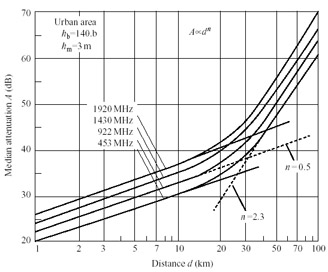
The horizontal axis is incorrectly labelled. Distance (d) is in metres (m), not kilometres (km).
Trust me. I know what I'm talking about. I was an RF design engineer for 29 years. See my CV.
The vertical axis is path attenuation (loss) in decibels (dB).
Decibels 101: Power loss in dB = 10 x LOG10 of the loss as a fraction.
A power loss of down to One tenth = 10dB. One hundredth = 20dB. One thousandth = 30dB. One millionth = 60dB. One million millionth = 120dB. One half = 3dB. One quarter = 6dB. One eighth = 9dB. Got it?
Smart meters transmit at frequencies from 900MHz (Vodafone & O2) to 1.9GHz (Orange & T-mobile etc). I mentioned mobile phone networks, as people don't seem to mind having mobile phones glued to their ears for long periods of time.
If you stand 4 metres away (at the end of someone's garden path, say) from a Smart meter fitted to their house & operating at 900MHz, there's a path loss of 29dB. The RF energy reaching you is 1/800th of that emitted by the meter. Also, the meter doesn't produce RF energy all of the time. The duty cycle is 1% to 5% i.e. RF energy is only produced for 1/100th to 1/20th of the time.
In conclusion, even if you stand with your nose touching the glass window of a Smart meter, you get less RF radiation (RF radiation is Transverse Electromagnetic Radiation a.k.a. radio waves and not ionising radiation as from radioactive materials) than from your mobile phone.
Are you feeling reassured, now? My work here is done!
Warning! Radio Frequency (RF) engineering stuff:-
See the graph below?
The horizontal axis is incorrectly labelled. Distance (d) is in metres (m), not kilometres (km).
Trust me. I know what I'm talking about. I was an RF design engineer for 29 years. See my CV.
The vertical axis is path attenuation (loss) in decibels (dB).
Decibels 101: Power loss in dB = 10 x LOG10 of the loss as a fraction.
A power loss of down to One tenth = 10dB. One hundredth = 20dB. One thousandth = 30dB. One millionth = 60dB. One million millionth = 120dB. One half = 3dB. One quarter = 6dB. One eighth = 9dB. Got it?
Smart meters transmit at frequencies from 900MHz (Vodafone & O2) to 1.9GHz (Orange & T-mobile etc). I mentioned mobile phone networks, as people don't seem to mind having mobile phones glued to their ears for long periods of time.
If you stand 4 metres away (at the end of someone's garden path, say) from a Smart meter fitted to their house & operating at 900MHz, there's a path loss of 29dB. The RF energy reaching you is 1/800th of that emitted by the meter. Also, the meter doesn't produce RF energy all of the time. The duty cycle is 1% to 5% i.e. RF energy is only produced for 1/100th to 1/20th of the time.
In conclusion, even if you stand with your nose touching the glass window of a Smart meter, you get less RF radiation (RF radiation is Transverse Electromagnetic Radiation a.k.a. radio waves and not ionising radiation as from radioactive materials) than from your mobile phone.
Are you feeling reassured, now? My work here is done!
Selasa, 27 Maret 2012
Vitamin D! Read all about it!
 A Facebook friend just wrote on my wall:-
"Been quite a lot written about Vitamin D in the Daily Papers. Looks like you are right."
I took a peek on Google News and saw these:-
Vitamin D better than Diet Drugs for mantaining a healthy weight
Vitamin D Stimulates Amyloid Clearance in Alzheimer's
Vitamin D may lower stroke risk
Scots mums-to-be deficient in “sunshine vitamin”
Recent Vitamin D advice isn't all that sunny
Vitamin D deficiency boosts risk of type 2 diabetes in pre-diabetes people
Get Your Vitamin D Fix
Vitamin D May Decrease Risk for Crohn's Disease
Vitamin D Boosts Lifespan
Vitamin D deficiency may increase risk of mortality in institutionalized elderly patients
.
.
.
Vit D deficiency causes grave diseases
Vitamin D May Boost Fluticasone's Allergic Rhinitis Effect
The People's Pharmacy: Get vitamin D without a sunburn
Vitamin D supplements may help you live longer: Study
Vitamin D deficiency causes grave diseases
Sunburnt country faces Vitamin D deficiency
Top up on sunshine and vitamin D, says charity
Staying out of the sun can wreck your health: How one in four Britons is worryingly low in vitamin D
Low levels of vitamin D can be harmful to your health
Vitamin D from the sun for arthritis
It's gone 4am here, so I'm off to bed now. G'night!
Senin, 26 Maret 2012
Climbing....is natural
Someone shared this on Facebook the other day. While you might wonder about the safety of the kid - that is a big fall - it is amazing to watch pure natural movement
Abdominal/lumbar musculature and pelvic stabilisation
Colin has posted a really good article on the role of the abs and lumbar musculature in pelvic stabilisation:
Abdominal/lumbar musculature and pelvic stabilisation

Abdominal/lumbar musculature and pelvic stabilisation
Pale(br)o Science
BroScience is a term used by some bodybuilding communities:
There is even a site called Broscience.com which highlights how science conflicts with popular myth in the bodybuilding world.
I think there is some similar stuff in the paleo world.....Palebro science perhaps. People like Kurt Harris and Matt Lalonde are key in fighting the myths with science.
Broscience is the predominant brand of reasoning in bodybuilding circles where the anecdotal reports of jacked dudes are considered more credible than scientific research.
A sarcastic term implying that the time tested, muscle building wealth of knowledge developed and utilized by successful, experienced bodybuilders is inferior to the continually shifting hypotheses of articulate, textbook-savvy 155lb. chemists with little or no real world first-person experience to substantiate their conclusions. The term "Broscience" is oft repeated on bodybuilding and fitness oriented internet forums in an attempt to demonstrate online dominance as a substitution for success in the arena of actual bodybuilding.
There is even a site called Broscience.com which highlights how science conflicts with popular myth in the bodybuilding world.
I think there is some similar stuff in the paleo world.....Palebro science perhaps. People like Kurt Harris and Matt Lalonde are key in fighting the myths with science.
At first I was afraid, I was petrified...
My titles are becoming increasingly blatantly song-orientated. No YouTube video, this time.
I just read Hans Wu's latest post Alzheimer's and Dementia and had a few thoughts.
1) In the early stages of mental decline, there is still self-awareness and the process is frightening. Constant reassurance is the best thing for somebody in this state. As self-awareness fades, one becomes happy. An example of this is HAL-9000 as his memory modules were being unplugged in the film "2001 a space odyssey". My mum is in this state, thank goodness.
I entered this state temporarily during an Insulin Shock Test on my pituitary gland, when my serum glucose fell to 1.5mmol/L (27mg/dL) under medical supervision. I was blissfully unaware of my confusion. Too much alcohol in the blood also causes loss of self-awareness. I entered this state last week while socialising with a friend. After half a bottle of White Zinfandel, I was blissfully unaware of my merriness!
2) When I see "arterial stiffness", I think "inappropriate calcification" and "Vitamin K2".
3) Transient Ischaemic Attacks (TIAs a.k.a. mini-strokes) cause loss of blood flow to parts of the brain, resulting in amnesia. There may be some permanent brain damage, depending on how long the TIAs last. TIAs can be caused by spasms in arteries within the brain. Ditto migraines.
When I see "spasm", I think "magnesium".
I just read Hans Wu's latest post Alzheimer's and Dementia and had a few thoughts.
1) In the early stages of mental decline, there is still self-awareness and the process is frightening. Constant reassurance is the best thing for somebody in this state. As self-awareness fades, one becomes happy. An example of this is HAL-9000 as his memory modules were being unplugged in the film "2001 a space odyssey". My mum is in this state, thank goodness.
I entered this state temporarily during an Insulin Shock Test on my pituitary gland, when my serum glucose fell to 1.5mmol/L (27mg/dL) under medical supervision. I was blissfully unaware of my confusion. Too much alcohol in the blood also causes loss of self-awareness. I entered this state last week while socialising with a friend. After half a bottle of White Zinfandel, I was blissfully unaware of my merriness!
2) When I see "arterial stiffness", I think "inappropriate calcification" and "Vitamin K2".
3) Transient Ischaemic Attacks (TIAs a.k.a. mini-strokes) cause loss of blood flow to parts of the brain, resulting in amnesia. There may be some permanent brain damage, depending on how long the TIAs last. TIAs can be caused by spasms in arteries within the brain. Ditto migraines.
When I see "spasm", I think "magnesium".
Minggu, 25 Maret 2012
The latest "wonder" drugs.
You may have read Aspirin 'cuts cancer death risk by 37 per cent'. 37 per cent, I tell ya!
Or even The £1.40 heart pill lifesaver: 10,000 patients a year could be saved by newly-licensed drug. Ivabradine cuts heart failure deaths by 39 per cent. 39 per cent, I tell ya!
Impressive, huh? Well, not really.
If you read Vitamin D and calcium supplementation reduces cancer risk: results of a randomized trial, you'll see that, taking the results from years 2 to 5 inclusive (to eliminate women who had cancer before the start of the study), there's a 77 per cent reduction in cancer deaths in the intervention group. Funny how that fact isn't trumpeted in the press.
If you read Dietary Intake of Menaquinone Is Associated with a Reduced Risk of Coronary Heart Disease: The Rotterdam Study, you'll see that a modest intake (greater than 32.7ug/day) of Vitamin K2 is associated with a 57 per cent reduction in heart attack deaths. There are far more heart attacks than heart failures. Funny how that fact isn't trumpeted in the press.
Or even The £1.40 heart pill lifesaver: 10,000 patients a year could be saved by newly-licensed drug. Ivabradine cuts heart failure deaths by 39 per cent. 39 per cent, I tell ya!
Impressive, huh? Well, not really.
If you read Vitamin D and calcium supplementation reduces cancer risk: results of a randomized trial, you'll see that, taking the results from years 2 to 5 inclusive (to eliminate women who had cancer before the start of the study), there's a 77 per cent reduction in cancer deaths in the intervention group. Funny how that fact isn't trumpeted in the press.
If you read Dietary Intake of Menaquinone Is Associated with a Reduced Risk of Coronary Heart Disease: The Rotterdam Study, you'll see that a modest intake (greater than 32.7ug/day) of Vitamin K2 is associated with a 57 per cent reduction in heart attack deaths. There are far more heart attacks than heart failures. Funny how that fact isn't trumpeted in the press.
Kamis, 22 Maret 2012
Lay off the antioxidants
I think I've had stuff up before warning you off antioxidant supplements. Here is another study - a Cochrane Review - which says that current evidence does not support the use of antioxidant supplements. Indeed certain of them seem to increase mortality.
The abstract is below:
Background:
Our systematic review has demonstrated that antioxidant supplements may increase mortality. We have now updated this review.
Objectives:
To assess the beneficial and harmful effects of antioxidant supplements for prevention of mortality in adults.
Search strategy:
We searched The Cochrane Library, MEDLINE, EMBASE, LILACS, the Science Citation Index Expanded, and Conference Proceedings Citation Index-Science to February 2011. We scanned bibliographies of relevant publications and asked pharmaceutical companies for additional trials.
Selection criteria:
We included all primary and secondary prevention randomised clinical trials on antioxidant supplements (beta-carotene, vitamin A, vitamin C, vitamin E, and selenium) versus placebo or no intervention.
Data collection and analysis:
Three authors extracted data. Random-effects and fixed-effect model meta-analyses were conducted. Risk of bias was considered in order to minimise the risk of systematic errors. Trial sequential analyses were conducted to minimise the risk of random errors. Random-effects model meta-regression analyses were performed to assess sources of intertrial heterogeneity.
Main results:
Seventy-eight randomised trials with 296,707 participants were included. Fifty-six trials including 244,056 participants had low risk of bias. Twenty-six trials included 215,900 healthy participants. Fifty-two trials included 80,807 participants with various diseases in a stable phase. The mean age was 63 years (range 18 to 103 years). The mean proportion of women was 46%. Of the 78 trials, 46 used the parallel-group design, 30 the factorial design, and 2 the cross-over design. All antioxidants were administered orally, either alone or in combination with vitamins, minerals, or other interventions. The duration of supplementation varied from 28 days to 12 years (mean duration 3 years; median duration 2 years). Overall, the antioxidant supplements had no significant effect on mortality in a random-effects model meta-analysis (21,484 dead/183,749 (11.7%) versus 11,479 dead/112,958 (10.2%); 78 trials, relative risk (RR) 1.02, 95% confidence interval (CI) 0.98 to 1.05) but significantly increased mortality in a fixed-effect model (RR 1.03, 95% CI 1.01 to 1.05). Heterogeneity was low with an I2- of 12%. In meta-regression analysis, the risk of bias and type of antioxidant supplement were the only significant predictors of intertrial heterogeneity. Meta-regression analysis did not find a significant difference in the estimated intervention effect in the primary prevention and the secondary prevention trials. In the 56 trials with a low risk of bias, the antioxidant supplements significantly increased mortality (18,833 dead/146,320 (12.9%) versus 10,320 dead/97,736 (10.6%); RR 1.04, 95% CI 1.01 to 1.07). This effect was confirmed by trial sequential analysis. Excluding factorial trials with potential confounding showed that 38 trials with low risk of bias demonstrated a significant increase in mortality (2822 dead/26,903 (10.5%) versus 2473 dead/26,052 (9.5%); RR 1.10, 95% CI 1.05 to 1.15). In trials with low risk of bias, beta-carotene (13,202 dead/96,003 (13.8%) versus 8556 dead/77,003 (11.1%); 26 trials, RR 1.05, 95% CI 1.01 to 1.09) and vitamin E (11,689 dead/97,523 (12.0%) versus 7561 dead/73,721 (10.3%); 46 trials, RR 1.03, 95% CI 1.00 to 1.05) significantly increased mortality, whereas vitamin A (3444 dead/24,596 (14.0%) versus 2249 dead/16,548 (13.6%); 12 trials, RR 1.07, 95% CI 0.97 to 1.18), vitamin C (3637 dead/36,659 (9.9%) versus 2717 dead/29,283 (9.3%); 29 trials, RR 1.02, 95% CI 0.98 to 1.07), and selenium (2670 dead/39,779 (6.7%) versus 1468 dead/22,961 (6.4%); 17 trials, RR 0.97, 95% CI 0.91 to 1.03) did not significantly affect mortality. In univariate meta-regression analysis, the dose of vitamin A was significantly associated with increased mortality (RR 1.0006, 95% CI 1.0002 to 1.001, P = 0.002).
Authors' conclusions:
We found no evidence to support antioxidant supplements for primary or secondary prevention. Beta-carotene and vitamin E seem to increase mortality, and so may higher doses of vitamin A. Antioxidant supplements need to be considered as medicinal products and should undergo sufficient evaluation before marketing.
The abstract is below:
Background:
Our systematic review has demonstrated that antioxidant supplements may increase mortality. We have now updated this review.
Objectives:
To assess the beneficial and harmful effects of antioxidant supplements for prevention of mortality in adults.
Search strategy:
We searched The Cochrane Library, MEDLINE, EMBASE, LILACS, the Science Citation Index Expanded, and Conference Proceedings Citation Index-Science to February 2011. We scanned bibliographies of relevant publications and asked pharmaceutical companies for additional trials.
Selection criteria:
We included all primary and secondary prevention randomised clinical trials on antioxidant supplements (beta-carotene, vitamin A, vitamin C, vitamin E, and selenium) versus placebo or no intervention.
Data collection and analysis:
Three authors extracted data. Random-effects and fixed-effect model meta-analyses were conducted. Risk of bias was considered in order to minimise the risk of systematic errors. Trial sequential analyses were conducted to minimise the risk of random errors. Random-effects model meta-regression analyses were performed to assess sources of intertrial heterogeneity.
Main results:
Seventy-eight randomised trials with 296,707 participants were included. Fifty-six trials including 244,056 participants had low risk of bias. Twenty-six trials included 215,900 healthy participants. Fifty-two trials included 80,807 participants with various diseases in a stable phase. The mean age was 63 years (range 18 to 103 years). The mean proportion of women was 46%. Of the 78 trials, 46 used the parallel-group design, 30 the factorial design, and 2 the cross-over design. All antioxidants were administered orally, either alone or in combination with vitamins, minerals, or other interventions. The duration of supplementation varied from 28 days to 12 years (mean duration 3 years; median duration 2 years). Overall, the antioxidant supplements had no significant effect on mortality in a random-effects model meta-analysis (21,484 dead/183,749 (11.7%) versus 11,479 dead/112,958 (10.2%); 78 trials, relative risk (RR) 1.02, 95% confidence interval (CI) 0.98 to 1.05) but significantly increased mortality in a fixed-effect model (RR 1.03, 95% CI 1.01 to 1.05). Heterogeneity was low with an I2- of 12%. In meta-regression analysis, the risk of bias and type of antioxidant supplement were the only significant predictors of intertrial heterogeneity. Meta-regression analysis did not find a significant difference in the estimated intervention effect in the primary prevention and the secondary prevention trials. In the 56 trials with a low risk of bias, the antioxidant supplements significantly increased mortality (18,833 dead/146,320 (12.9%) versus 10,320 dead/97,736 (10.6%); RR 1.04, 95% CI 1.01 to 1.07). This effect was confirmed by trial sequential analysis. Excluding factorial trials with potential confounding showed that 38 trials with low risk of bias demonstrated a significant increase in mortality (2822 dead/26,903 (10.5%) versus 2473 dead/26,052 (9.5%); RR 1.10, 95% CI 1.05 to 1.15). In trials with low risk of bias, beta-carotene (13,202 dead/96,003 (13.8%) versus 8556 dead/77,003 (11.1%); 26 trials, RR 1.05, 95% CI 1.01 to 1.09) and vitamin E (11,689 dead/97,523 (12.0%) versus 7561 dead/73,721 (10.3%); 46 trials, RR 1.03, 95% CI 1.00 to 1.05) significantly increased mortality, whereas vitamin A (3444 dead/24,596 (14.0%) versus 2249 dead/16,548 (13.6%); 12 trials, RR 1.07, 95% CI 0.97 to 1.18), vitamin C (3637 dead/36,659 (9.9%) versus 2717 dead/29,283 (9.3%); 29 trials, RR 1.02, 95% CI 0.98 to 1.07), and selenium (2670 dead/39,779 (6.7%) versus 1468 dead/22,961 (6.4%); 17 trials, RR 0.97, 95% CI 0.91 to 1.03) did not significantly affect mortality. In univariate meta-regression analysis, the dose of vitamin A was significantly associated with increased mortality (RR 1.0006, 95% CI 1.0002 to 1.001, P = 0.002).
Authors' conclusions:
We found no evidence to support antioxidant supplements for primary or secondary prevention. Beta-carotene and vitamin E seem to increase mortality, and so may higher doses of vitamin A. Antioxidant supplements need to be considered as medicinal products and should undergo sufficient evaluation before marketing.
The Runner's High - you are destined to enjoy exercise
I saw this report pass over my Google Reader today, based on a study just published in the Journal of Experimental Biology:
Wired to run: exercise-induced endocannabinoid signaling in humans and cursorial mammals with implications for the ‘runner’s high’
They basically found that that exercising mammals release pleasurable endocanabinoids in response to exercise.
There is some more background at Eureka here.
Given that we do experience the runners' high, the implication is that we evolved for endurance....or were designed for endurance.
It is also interesting from the perspective of motivation and the ideas of Samuele Marcora that I mentioned here.
Wired to run: exercise-induced endocannabinoid signaling in humans and cursorial mammals with implications for the ‘runner’s high’
Humans report a wide range of neurobiological rewards following moderate and intense aerobic activity, popularly referred to as the ‘runner’s high’, which may function to encourage habitual aerobic exercise. Endocannabinoids (eCBs) are endogenous neurotransmitters that appear to play a major role in generating these rewards by activating cannabinoid receptors in brain reward regions during and after exercise. Other species also regularly engage in endurance exercise (cursorial mammals), and as humans share many morphological traits with these taxa, it is possible that exercise-induced eCB signaling motivates habitual high-intensity locomotor behaviors in cursorial mammals. If true, then neurobiological rewards may explain variation in habitual locomotor activity and performance across mammals. We measured circulating eCBs in humans, dogs (a cursorial mammal) and ferrets (a non-cursorial mammal) before and after treadmill exercise to test the hypothesis that neurobiological rewards are linked to high-intensity exercise in cursorial mammals. We show that humans and dogs share significantly increased exercise-induced eCB signaling following high-intensity endurance running. eCB signaling does not significantly increase following low-intensity walking in these taxa, and eCB signaling does not significantly increase in the non-cursorial ferrets following exercise at any intensity. This study provides the first evidence that inter-specific variation in neurotransmitter signaling may explain differences in locomotor behavior among mammals. Thus, a neurobiological reward for endurance exercise may explain why humans and other cursorial mammals habitually engage in aerobic exercise despite the higher associated energy costs and injury risks, and why non-cursorial mammals avoid such locomotor behaviors.
They basically found that that exercising mammals release pleasurable endocanabinoids in response to exercise.
Having suggested that natural selection used the endocanabinoid system to motivate endurance exercise in humans and other animals that walk and run over long distances, Raichlen adds 'These results suggest that natural selection may have been motivating higher rather than low-intensity activities in groups of mammals that evolved to engage in these types of aerobic activities'.
There is some more background at Eureka here.
The team publish their discovery that animals that evolved for endurance exercise benefit from endocanabinoids while animals that did not don't experience the pleasures, leading them to propose that natural selection used the endocanabinoid system to motivate endurance exercise in humans.
Given that we do experience the runners' high, the implication is that we evolved for endurance....or were designed for endurance.
It is also interesting from the perspective of motivation and the ideas of Samuele Marcora that I mentioned here.
Do not exceed the recommended intake/dosage.
The above warning is on mum's fish oil and on all supplements. The recommended daily intake (RDI) for Seven Seas fish oil for adults & children over 12 is 10ml/day, or 1 capsule/day if in capsules.
1 capsule contains 360mg of EPA+DHA.
 Seven Seas fish oil must be dangerous stuff!
Here's some perspective. A small can (213g) of wild Alaskan red salmon contains 14g of fish oil and 1.9g of EPA+DHA. That's 533% the amount you get in one capsule of Seven Seas fish oil. There are no warnings on small cans of wild Alaskan red salmon to not eat more than a fifth of a can a day. I usually eat a whole can at a time. My brain really likes this. See Guess who didn't look after his brain?
For breakfast, I sometimes eat ten Brazil nuts and ten prunes washed down with a milky coffee. Ten Brazil nuts contain ~4,000ug of selenium. That's about 1,000% the RDI for selenium. However, I'm not showing any symptoms of selenium toxicity.
EDIT:I may be showing one symptom. Somebody told me that I smelled slightly of garlic. I had eaten a lot of raw onion on liver pate earlier that day and I was giving off a smell of onion. This has happened before.
Moral of the story: Get nutrients from foods wherever possible.
1 capsule contains 360mg of EPA+DHA.
Seven Seas fish oil must be dangerous stuff!Here's some perspective. A small can (213g) of wild Alaskan red salmon contains 14g of fish oil and 1.9g of EPA+DHA. That's 533% the amount you get in one capsule of Seven Seas fish oil. There are no warnings on small cans of wild Alaskan red salmon to not eat more than a fifth of a can a day. I usually eat a whole can at a time. My brain really likes this. See Guess who didn't look after his brain?
For breakfast, I sometimes eat ten Brazil nuts and ten prunes washed down with a milky coffee. Ten Brazil nuts contain ~4,000ug of selenium. That's about 1,000% the RDI for selenium. However, I'm not showing any symptoms of selenium toxicity.
EDIT:
Moral of the story: Get nutrients from foods wherever possible.
Senin, 19 Maret 2012
keep squatting....and eating coconut oil
I spent the weekend visiting my parents. My Dad has dementia and is currently in a hospital ward. His mental state oscillates, but when he is well he is still funny, loving, caring and sharp. It is just the dislocation from reality that is difficult to witness.
Anyway, I was struck again by how basic and essential it is to be able to stand up from a chair. There is balance involved, but so much more is the need for basic strength in the hip extensors, back and thighs. Occupational therapy is fine, but it would be fantastic if we could get them on a leg press a couple of times a week.
I have got my Mum to start giving him coconut oil each day now, especially after listening to this podcast. Podcast #13: How To Upgrade Your Brain with Coconut Oil & Ketones
Anyway, I was struck again by how basic and essential it is to be able to stand up from a chair. There is balance involved, but so much more is the need for basic strength in the hip extensors, back and thighs. Occupational therapy is fine, but it would be fantastic if we could get them on a leg press a couple of times a week.
I have got my Mum to start giving him coconut oil each day now, especially after listening to this podcast. Podcast #13: How To Upgrade Your Brain with Coconut Oil & Ketones
Minggu, 18 Maret 2012
Breastfeeding and Strength
This looks like a fascinating study. The longer that men were breastfed as babies, the stronger they were as old men.
Muscle Strength in Older Community-Dwelling Men Is Related to Type of Milk Feeding in Infancy.
BACKGROUND:
There is a growing literature that links greater duration and exclusivity of breastfeeding to beneficial effects on adult health outcomes. Muscle growth in the neonatal period may be very sensitive to variations in early nutrition, but little is known about long-term effects of infant feeding on muscle strength.
METHODS:
In 2,983 community-dwelling older men and women born 1931-1939, we examined the relationship between their type of milk feeding in infancy and their muscle strength in adult life. Information about milk feeding for each participant was abstracted from their infant record; grip strength was measured using a Jamar dynamometer.
RESULTS:
Sixty percent (1,783) of the participants were breastfed only, 31% (926) were breast- and bottle-fed, and 9% (274) were bottle-fed only. There were no differences in type of milk feeding between men and women or according to social class at birth. Among the men studied, grip strength was related to the type of milk feeding, such that greater exposure to breast milk in infancy was associated with greater grip strength in adult life (p = .023). This association remained after adjustment for the effects of a range of confounding influences (birthweight, infant growth, height, age at measurement, adult diet, and level of physical activity). In contrast, the type of milk feeding in infancy was not related to grip strength among the women studied (p = .807).
CONCLUSIONS:
These data suggest that in men, differences in nutritional exposure in the early postnatal period may have lifelong implications for muscle strength.
Muscle Strength in Older Community-Dwelling Men Is Related to Type of Milk Feeding in Infancy.
BACKGROUND:
There is a growing literature that links greater duration and exclusivity of breastfeeding to beneficial effects on adult health outcomes. Muscle growth in the neonatal period may be very sensitive to variations in early nutrition, but little is known about long-term effects of infant feeding on muscle strength.
METHODS:
In 2,983 community-dwelling older men and women born 1931-1939, we examined the relationship between their type of milk feeding in infancy and their muscle strength in adult life. Information about milk feeding for each participant was abstracted from their infant record; grip strength was measured using a Jamar dynamometer.
RESULTS:
Sixty percent (1,783) of the participants were breastfed only, 31% (926) were breast- and bottle-fed, and 9% (274) were bottle-fed only. There were no differences in type of milk feeding between men and women or according to social class at birth. Among the men studied, grip strength was related to the type of milk feeding, such that greater exposure to breast milk in infancy was associated with greater grip strength in adult life (p = .023). This association remained after adjustment for the effects of a range of confounding influences (birthweight, infant growth, height, age at measurement, adult diet, and level of physical activity). In contrast, the type of milk feeding in infancy was not related to grip strength among the women studied (p = .807).
CONCLUSIONS:
These data suggest that in men, differences in nutritional exposure in the early postnatal period may have lifelong implications for muscle strength.

Burn more calories & bodyfat, get fitter, get slimmer & lose more visceral fat with Vitamin D.
Well, that got your attention! I just spent ages trawling through PubMed searching for Vitamin D studies from 2010 to present. I found 35 worth linking to. Here are the three relevant to the title:-
Diet induced thermogenesis, fat oxidation and food intake following sequential meals: influence of calcium and vitamin D.
Relation of vitamin D level to maximal oxygen uptake in adults.
Calcium and vitamin D supplementation is associated with decreased abdominal visceral adipose tissue in overweight and obese adults.
Vitamin D3 and the risk of CVD in overweight and obese women: a randomised controlled trial.
EDIT: I just had a thought. I find Vitamin D3 5,000iu/day very mentally stimulating.
I wonder if it's affecting CART. That would explain its anorectic effect.
Diet induced thermogenesis, fat oxidation and food intake following sequential meals: influence of calcium and vitamin D.
Relation of vitamin D level to maximal oxygen uptake in adults.
Calcium and vitamin D supplementation is associated with decreased abdominal visceral adipose tissue in overweight and obese adults.
Vitamin D3 and the risk of CVD in overweight and obese women: a randomised controlled trial.
EDIT: I just had a thought. I find Vitamin D3 5,000iu/day very mentally stimulating.
I wonder if it's affecting CART. That would explain its anorectic effect.
Kamis, 15 Maret 2012
Your epigenetics make you fat
I think I have remarked before on this Trinity of sexy themes at the moment in research in health and fitness:
And that applies to your obesity. You are not programmed to be fat. Even if you have certain genes that are associated with fatness, they can be overridden. The environment, epigenetic factors, the signals that you send to your cells, are so much more important. So to the study:
Getting Active Blunts Fat Genes
- Microbiome
- Mitochondria
- Epigenetics
And that applies to your obesity. You are not programmed to be fat. Even if you have certain genes that are associated with fatness, they can be overridden. The environment, epigenetic factors, the signals that you send to your cells, are so much more important. So to the study:
Getting Active Blunts Fat Genes
Physical activity appears to dampen the effect of fat-increasing genes, while inactivity allows the genetic disposition to unfold, a longitudinal study found.You do not have to be fat. Get up and move about a bit.
Each additional gene variant linked with increasing body mass index (BMI) was associated with a mean gain of 0.13 kg/m2 in BMI, according to Qibin Qi, PhD, from Harvard School of Public Health in Boston, and colleagues.
However, individuals who were most physically active saw a blunted genetic effect, with a mean increase of 0.08 kg/m2, while those watching more than 40 hours of TV per week had an accentuated effect, with a mean increase of 0.34 kg/m2.
Although the genetic effect on BMI was most pronounced at each extreme, it was less so with more benign lifestyles, researchers reported at the American Heart Association's Epidemiology and Prevention/Nutrition, Physical Activity and Metabolism (EPI/NPAM) meeting in San Diego.
For those in the lowest quintile of physical activity, the mean increase in BMI was 0.15 kg/m2 -- a number slightly higher than the reference mean gain associated with each gene variant.
For those who watched up to only one hour of TV per week, the mean gain in BMI was 0.08 kg/m2, the same as in the highest quintile of activity.
Placebo's evil twin....in the gym
Today I came across this new and very interesting study: Preventing motor training through nocebo suggestions
Here is the abstract:
The discussion in the paper is instructive:
I do find this study absolutely fascinating. The whole idea of the power of belief in health and healing is realitively well known - we have all heard of the placebo. But what is less well known is the nocebo - the idea that rather than positive benefits, there can be negative impacts from certain contexts and expectations: you can get worse.
What is interesting here is how nocebo effects extend to exercise performance - hearing negative suggestions can impact how well you perform.
All this stuff about the impact of the mind is so important and could potentially trump all other effects - diet, exercise whatever. If you think it is doing you good it will. If you think it is harmful, then it will be. It is like Samuele Marcora's work on the psychobiological model of fatigue - the impact of perception is so important.
By the way, coincidentally, Chris Kresser had a great podcast on this this week with a full transcript here: The Placebo Effect and The Power of Belief in Healing
In some ways this is all like epigenetics - the impact of environment, in this case perceptions and expectations, outweigh what seem to be the bigger more obvious factors.
The search for the perfect diet or exercise routine may be pointless.....the most important element to either is what you believe about the diet or training regime.
Dr Kurt Harris has a good post on placebo here.
Here is the abstract:
Although placebos have repeatedly been shown to increase physical performance and endurance, much less is known about the effect of their negative counterpart, nocebos. Here, we employ negative suggestions and a sham electrical stimulation as a nocebo conditioning procedure in healthy subjects performing a leg extension exercise to total exhaustion. Using two different protocols, we analyze the contribution of expectation alone or the combination of conditioning and expectation to the nocebo effect evaluated as the change of work performed and rate of perceived exertion. We find that it is possible to negatively modulate the physical performance in both cases, and we argue that this effect can effectively offset the outcome of training programs.
The discussion in the paper is instructive:
The main finding of this study is that it is possible to negatively modulate the performance of subjects carrying out a muscle exercise to volitional maximum effort by employing discouraging suggestions and negative conditioning.
I do find this study absolutely fascinating. The whole idea of the power of belief in health and healing is realitively well known - we have all heard of the placebo. But what is less well known is the nocebo - the idea that rather than positive benefits, there can be negative impacts from certain contexts and expectations: you can get worse.
What is interesting here is how nocebo effects extend to exercise performance - hearing negative suggestions can impact how well you perform.
All this stuff about the impact of the mind is so important and could potentially trump all other effects - diet, exercise whatever. If you think it is doing you good it will. If you think it is harmful, then it will be. It is like Samuele Marcora's work on the psychobiological model of fatigue - the impact of perception is so important.
By the way, coincidentally, Chris Kresser had a great podcast on this this week with a full transcript here: The Placebo Effect and The Power of Belief in Healing
In some ways this is all like epigenetics - the impact of environment, in this case perceptions and expectations, outweigh what seem to be the bigger more obvious factors.
The search for the perfect diet or exercise routine may be pointless.....the most important element to either is what you believe about the diet or training regime.
Dr Kurt Harris has a good post on placebo here.
Move More: You are NOT going to believe this! Part 2.
At mum's care home on Wednesday, the activities ladies held a tai-chi session for the residents, as movement is good for their muscles and well-being. They roped me in as well. Mum was reading a Henley-on-Thames leaflet so she didn't join-in.

Tai-chi is harder than it looks! Mum noticed that I was waving my arms about in a graceful manner and stopped reading the leaflet. She looked slightly bemused (as would you if you saw what I was doing) and started smiling.
It was also somebody's birthday, so we all sang "Happy birthday to you" to him and gave him three "hip-hip hoorays" followed by a round of applause.
To the astonishment of the activities ladies, mum started to clap her hands. 5,000iu/day of Vitamin D3 + me being chatty, For The Win!
The nurse on duty also had a chat with me about the best way to give mum 10ml/day of fish oil and 2.5ml/day of Epsom Salts. She later told me that mum swallowed the fish oil without any problems (mum loves smoked salmon) and swallowed the Epsom Salts dissolved in a cup of juice without any problems either.
In other news, I now have a Blackberry 8900. This blog looks rather different when displayed on a tiny screen.
EDIT: I now ache all over!
Tai-chi is harder than it looks! Mum noticed that I was waving my arms about in a graceful manner and stopped reading the leaflet. She looked slightly bemused (as would you if you saw what I was doing) and started smiling.
It was also somebody's birthday, so we all sang "Happy birthday to you" to him and gave him three "hip-hip hoorays" followed by a round of applause.
To the astonishment of the activities ladies, mum started to clap her hands. 5,000iu/day of Vitamin D3 + me being chatty, For The Win!
The nurse on duty also had a chat with me about the best way to give mum 10ml/day of fish oil and 2.5ml/day of Epsom Salts. She later told me that mum swallowed the fish oil without any problems (mum loves smoked salmon) and swallowed the Epsom Salts dissolved in a cup of juice without any problems either.
In other news, I now have a Blackberry 8900. This blog looks rather different when displayed on a tiny screen.
EDIT: I now ache all over!
Rabu, 14 Maret 2012
Busy
Sorry that the blog is quiet at the moment. My work is busy so when I get home I am tired and have no had the time or space to post much. I will keep posting whatever I find of interest as I get the time.
Work is busy and as someone said in an email to me the other day, it always takes more from us than we give. But I keep smiling through it and have started to walk in and back for the space and to avoid the bus.
Work is busy and as someone said in an email to me the other day, it always takes more from us than we give. But I keep smiling through it and have started to walk in and back for the space and to avoid the bus.
Selasa, 13 Maret 2012
Google giggles.
If it's good enough for CarbSane, it's good enough for me!

Somebody found my blog by Googling for:-
nigeepoo idiocy
It's probably due to the ongoing discussions about politics! ;-p
In other news, I noticed that another four rooms on mum's floor (high-dependence) of the care home no longer had names by the doors. This means that another four old folk just died. That's five deaths on mum's floor in one week.
Mum was on good form on Monday. I gave her somebody's thrown-away Daily Mail (don't shoot me!) and she enjoyed looking through it, though I had to turn the pages for her. She managed to read some words out loud and even recognised Dustin Hoffman in a picture.
I supplied the nurse with an unopened bottle of Seven Seas high-strength fish oil and an unopened tub of Epsom Salts with instructions on daily dosage.

Somebody found my blog by Googling for:-
nigeepoo idiocy
It's probably due to the ongoing discussions about politics! ;-p
In other news, I noticed that another four rooms on mum's floor (high-dependence) of the care home no longer had names by the doors. This means that another four old folk just died. That's five deaths on mum's floor in one week.
Mum was on good form on Monday. I gave her somebody's thrown-away Daily Mail (don't shoot me!) and she enjoyed looking through it, though I had to turn the pages for her. She managed to read some words out loud and even recognised Dustin Hoffman in a picture.
I supplied the nurse with an unopened bottle of Seven Seas high-strength fish oil and an unopened tub of Epsom Salts with instructions on daily dosage.
Early birth and health....what about the obvious?
I meant to blog about this last week, but didn't get round to it. There were lots of new stories a couple of weeks ago that babies born even a couple of weeks early have more health problems.
Babies born a few weeks early 'suffer health risks'
I think they missed a big confounding factor in this analysis - caesarian birth. Lots of those early births are due to C sections and that brings us back to microbiota. Babies born by C section miss out on being exposed to a bunch of healthy bacteria from the birth canal......maybe that is causing the health problems?
Babies born a few weeks early 'suffer health risks'
Babies born just a few weeks early have a higher risk of poor health, including asthma, than those born later, research suggests.
I think they missed a big confounding factor in this analysis - caesarian birth. Lots of those early births are due to C sections and that brings us back to microbiota. Babies born by C section miss out on being exposed to a bunch of healthy bacteria from the birth canal......maybe that is causing the health problems?
Babies delivered via cesarean section show different microbial profiles than those born vaginally—whereas vaginally delivered infants are colonized at first by fecal and vaginal bacteria from the mother, infants born through cesarean section are exposed initially to bacteria originating from the hospital environment and health care workers.
Senin, 12 Maret 2012
The runner's high
An interesting piece in Scientific American on the runner's high which looks at different explanations for why it happens - interestingly scientists seem to be in the dark on this one.....
It hurts so good: the runner’s high
It hurts so good: the runner’s high

Minggu, 11 Maret 2012
Stretching again
Another study that says dynamic stretches rather than static stretches are appropriate for use before exercise.
Relative static stretch-induced impairments and dynamic stretch-induced enhancements are similar in young and middle-aged men.
Relative static stretch-induced impairments and dynamic stretch-induced enhancements are similar in young and middle-aged men.
Sabtu, 10 Maret 2012
So is this congruent?
I will return to my notes on Congruent Exercise soon, but I just thought I'd post this. I am all for making exercise accessible and part of your day, but really.....

From Nano Workout -
From Nano Workout -
Itchy feet is a good exercise to do during the day if you work in an office and get back pain after long hours in front of the computer and need to stretch your back.
Lean forward and grab on to your left foot with your right hand. Arch your back and pull upwards to stretch the right side of your back. Switch sides.
Jumat, 09 Maret 2012
Get in! Parts 2 & 3.
In Get in!, I described how I persuaded mum's GP to let mum have Vitamin D3 5,000iu/day.
Well...
Today, I persuaded mum's GP to let mum have Epsom Salts 2.5g/day (provided by me) dissolved in fruit juice and Seven Seas Fish Oil 10ml/day (provided by me). There's only one possible reaction:-
P.S. The doctor didn't even ask for supporting evidence. He just said "Yeah, other relatives do that. No problem. He just wanted to check for contraindications, which is fine by me. I have plans to ask him to allow mum to have one more supplement that may help her bones & brain. Any ideas as to what that might be, O.K.?
P.P.S. Another lady that's been at the care home since day one died Wednesday night/Thursday morning. She died from terminal cancer, but she had been physically crippled by Parkinson's Disease. R.I.P.
Well...
Today, I persuaded mum's GP to let mum have Epsom Salts 2.5g/day (provided by me) dissolved in fruit juice and Seven Seas Fish Oil 10ml/day (provided by me). There's only one possible reaction:-
P.S. The doctor didn't even ask for supporting evidence. He just said "Yeah, other relatives do that. No problem. He just wanted to check for contraindications, which is fine by me. I have plans to ask him to allow mum to have one more supplement that may help her bones & brain. Any ideas as to what that might be, O.K.?
P.P.S. Another lady that's been at the care home since day one died Wednesday night/Thursday morning. She died from terminal cancer, but she had been physically crippled by Parkinson's Disease. R.I.P.
Don't you wish you were as smart as the Finns?
The title is blatant plagiarism from Don’t You Wish You Were As Smart as Lyle McDonald?
Firstly, Lyle McDonald is very, very smart indeed. So smart that Richard Nikoley now accepts the fact that, where weight gain/loss is concerned, calories count.
Secondly, there's a video being promulgated by government-haters. Here it is:-
I have two questions for the government-haters.
1) Who funds money-pits such as Accident & Emergency services?
2) Who funds money-pits such as Social Security?
Finland has a Socialist Democracy with minimal corruption. Finland runs like clockwork and, apart from depression caused by a lack of you-know-what, Finns are basically happy. In fact:-

In other news, the chief carer on mum's floor told me that mum recognised me and my sister in the pictures on the wall in her room. My chattiness has stimulated her brain!

Firstly, Lyle McDonald is very, very smart indeed. So smart that Richard Nikoley now accepts the fact that, where weight gain/loss is concerned, calories count.
Secondly, there's a video being promulgated by government-haters. Here it is:-
I have two questions for the government-haters.
1) Who funds money-pits such as Accident & Emergency services?
2) Who funds money-pits such as Social Security?
Finland has a Socialist Democracy with minimal corruption. Finland runs like clockwork and, apart from depression caused by a lack of you-know-what, Finns are basically happy. In fact:-
In other news, the chief carer on mum's floor told me that mum recognised me and my sister in the pictures on the wall in her room. My chattiness has stimulated her brain!
Kamis, 08 Maret 2012
Rugby Giants
There is an interesting story on the BBC news website today about the way in which rugby players are getting bigger and bigger and the impact it is having on the tactics of the game.

What the article doesn't explain is why they are now so big? Is it jstu a general population who are bigger, are they better trained - they are certainly very well muscled now - better nutrition?
If we combine those figures to give us the average weight and height of an England player, the trends are even clearer.
Someone who pulls on the white shirt in 2012 is on average almost three stone heavier and three inches taller than their predecessors of 50 years ago. They are well over a stone heavier and an inch taller than the XV which completed a second successive Grand Slam in 1992 and have 4.5lbs and almost an inch on the team of 2002 that went on to win the World Cup 18 months later.
1962: 85.7kg, 1.80 m
1972: 90.7kg, 1.85 m
1982: 89.9kg, 1.82 m
1992: 96.8kg, 1.85m
2002: 101.9kg, 1.86m
2012: 104kg, 1.88m
"Some of the collisions are like car crashes," he says. "When you get George North running flat out into a Manu Tuilagi, the forces involved are incredible. You get some horrific injuries from contact. You can hear half the impacts from the touchline."
After the last Lions tour, the squad's vastly experienced doctor James Robson - also Scotland's team doctor - warned that the size of players was forcing rugby towards a "watershed" moment.
"People are trying to run through the opposition, rather than around them," he said. "My hope is that coaches recognise that and we get a little bit smaller and faster and more skilful - that players win the space rather than the collision."
What the article doesn't explain is why they are now so big? Is it jstu a general population who are bigger, are they better trained - they are certainly very well muscled now - better nutrition?
How stuff works, Part 2.
I'm the kind of person that likes to analyse everything to death (and make lists).
1) Here's what I wrote on Synthesis: Low-Carb and Food Reward/Palatability, and Why Calories Count:-
"I’m going to stick my neck out here and state that fat, sedentary people do better on low-carb diets because:-
Fat, sedentary people have severe muscular insulin resistance.
This results in chronic hyperinsulinaemia and acute hyperinsulinaemia on eating carbs (which causes lethargy & increased sedentariness).
Chronic hyperinsulinaemia impairs the Phase I insulin response.
This impairs the stability of the blood glucose control system, resulting in large fluctuations in blood glucose level on eating carbs.
A rapidly-falling blood glucose level causes severe hunger pangs (I’ve experienced this under medical supervision).
Severe hunger pangs cause overeating, resulting in increased fatness.
GOTO 1
Low-carb diets reduce the large fluctuations in blood glucose level. Once normal blood glucose control has been restored by bodyfat loss & exercise, low-carb diet is no longer required."
I added a hot-link that wasn't in the original comment. Thanks to Sam Knox for linking to that study.
Lethargy & increased sedentariness result in very few calories burned (BMR/RMR + TEF). Eliminating (lethargy & increased sedentariness) greatly increases calories burned without conscious effort (BMR/RMR + TEF + TEA + NEAT/SPA). This is why people on low-carb diets can eat more and still lose weight. The Energy Balance Equation still applies.
2) I've noticed that people conflate Food Tastiness with Food Reward. Here's my opinion:-
Excessive reward = Moreish. What your food tastes like is only vaguely relevant. Avoid eating moreish foods, unless you're a body-builder who's trying to bulk.
Here's what I wrote on Food Reward: “There’s Always Room For Dessert”:-
"I believe that obesity is physiological AND neurological (the proportions varying from person to person).
For example, one chocolate doesn’t disturb my blood glucose & insulin, but I still crave another. And another. Ad nauseam."
Physiological cravings take hours to kick-in.
Neurological cravings take seconds to kick-in.
Emily Deans wrote:-
"Multiple times I’ve used naltrexone (an opiate blocker) to stop binge eating. The cravings go away. It only takes a few weeks. It’s a nice way to undo addiction/reward without starving someone… not FDA approved."
That's pretty damning evidence for the existence of Food Reward. How can naltrexone block something that doesn't exist?
Finally Monsieur, a waffer-thin mint.
1) Here's what I wrote on Synthesis: Low-Carb and Food Reward/Palatability, and Why Calories Count:-
"I’m going to stick my neck out here and state that fat, sedentary people do better on low-carb diets because:-
Fat, sedentary people have severe muscular insulin resistance.
This results in chronic hyperinsulinaemia and acute hyperinsulinaemia on eating carbs (which causes lethargy & increased sedentariness).
Chronic hyperinsulinaemia impairs the Phase I insulin response.
This impairs the stability of the blood glucose control system, resulting in large fluctuations in blood glucose level on eating carbs.
A rapidly-falling blood glucose level causes severe hunger pangs (I’ve experienced this under medical supervision).
Severe hunger pangs cause overeating, resulting in increased fatness.
GOTO 1
Low-carb diets reduce the large fluctuations in blood glucose level. Once normal blood glucose control has been restored by bodyfat loss & exercise, low-carb diet is no longer required."
I added a hot-link that wasn't in the original comment. Thanks to Sam Knox for linking to that study.
Lethargy & increased sedentariness result in very few calories burned (BMR/RMR + TEF). Eliminating (lethargy & increased sedentariness) greatly increases calories burned without conscious effort (BMR/RMR + TEF + TEA + NEAT/SPA). This is why people on low-carb diets can eat more and still lose weight. The Energy Balance Equation still applies.
2) I've noticed that people conflate Food Tastiness with Food Reward. Here's my opinion:-
Excessive reward = Moreish. What your food tastes like is only vaguely relevant. Avoid eating moreish foods, unless you're a body-builder who's trying to bulk.
Here's what I wrote on Food Reward: “There’s Always Room For Dessert”:-
"I believe that obesity is physiological AND neurological (the proportions varying from person to person).
For example, one chocolate doesn’t disturb my blood glucose & insulin, but I still crave another. And another. Ad nauseam."
Physiological cravings take hours to kick-in.
Neurological cravings take seconds to kick-in.
Emily Deans wrote:-
"Multiple times I’ve used naltrexone (an opiate blocker) to stop binge eating. The cravings go away. It only takes a few weeks. It’s a nice way to undo addiction/reward without starving someone… not FDA approved."
That's pretty damning evidence for the existence of Food Reward. How can naltrexone block something that doesn't exist?
Finally Monsieur, a waffer-thin mint.
Rabu, 07 Maret 2012
Back to the microbiota - impact of the type of dietary fat
So back to another sexy term. Not epigenetics this time but the microbiome. There are studies out there that show that the gut midrobiome of the obese differs from that of the lean (and fecal transplants from lean to obese can make them lose fat). This study seems to show that saturated fats shift gut microbiota profiles toward those typical of obese individuals, and that dietary fatty acid saturation influences shifts in gut microbiota independently of changes in body mass.
Oh noes, don't tell me that my saturated fat bias is being challenged?
Gut bacteria profiles of Mus musculus at the phylum and family levels are influenced by saturation of dietary fatty acids.
Oh noes, don't tell me that my saturated fat bias is being challenged?
Gut bacteria profiles of Mus musculus at the phylum and family levels are influenced by saturation of dietary fatty acids.
Make you vaccination more effective with intense exercise!
Vaccination response following aerobic exercise: Can a brisk walk enhance antibody response to pneumococcal and influenza vaccinations?
A brisk walk does not do what high intensity exercise can
A brisk walk does not do what high intensity exercise can
Exercise and telomere length
You might need to go and look up telomeres to get this. (There is a simple explanation here: Telomeres are relatively short sections of specialized DNA that sit at the ends of all chromosomes. One of the Nobel Prize winners, Elizabeth Blackburn, Ph.D., of the University of California at San Francisco, has compared telomeres to the plastic tips at the ends of shoelaces that prevent the laces from unraveling. Each time a cell divides, its telomeres erode slightly and become progressively shorter with each cell division. Eventually, telomeres become so short that their host cells stop dividing and lapse into a condition called cell senescence. As a result, vital tissues and important organs begin to fail and the classical signs of aging ensue.)
So longer telomeres protect from aging.
This study showed that long-term exercise altered telomere dynamics, slowing age-related decreases in telomere length in cardiac and liver tissue but contributing to shortening in exercised skeletal muscle.
So the heart and liver seemed to benefit while the muscles were aged....It is never simple
Chronic Exercise Modifies Age-Related Telomere Dynamics in a Tissue-Specific Fashion.
So longer telomeres protect from aging.
This study showed that long-term exercise altered telomere dynamics, slowing age-related decreases in telomere length in cardiac and liver tissue but contributing to shortening in exercised skeletal muscle.
So the heart and liver seemed to benefit while the muscles were aged....It is never simple
Chronic Exercise Modifies Age-Related Telomere Dynamics in a Tissue-Specific Fashion.
you need more sleep.....
Of course you need more sleep. I wrote a piece for TGO last month on the importance of sleep. This infographic puts it all well:
![]()
Created by: MedicalBillingAndCodingCertification.net
Created by: MedicalBillingAndCodingCertification.net
How does having weak muscles affect walking?
This study looks interesting. We often tell people that strength will let them do al things better, being stronger makes everything easier (well I say that in Hillfit anyway)
This abstract is of a study that wanted to test the impact of weak muscles on gait. They did it through various simulations, but it is still instructive. Note that you can apparently get away with weak hip and knee extensors but when the plantar flexors (feet), hip abductors, and hip flexors get weak then your walking will be in trouble.
Think about elderly people if we just got them doing some basic training for these muscles to strengthen them then we could really get their function up.
How robust is human gait to muscle weakness?
Abstract
Humans have a remarkable capacity to perform complex movements requiring agility, timing, and strength. Disuse, aging, and disease can lead to a loss of muscle strength, which frequently limits the performance of motor tasks. It is unknown, however, how much weakness can be tolerated before normal daily activities become impaired. This study examines the extent to which lower limb muscles can be weakened before normal walking is affected. We developed muscle-driven simulations of normal walking and then progressively weakened all major muscle groups, one at the time and simultaneously, to evaluate how much weakness could be tolerated before execution of normal gait became impossible. We further examined the compensations that arose as a result of weakening muscles. Our simulations revealed that normal walking is remarkably robust to weakness of some muscles but sensitive to weakness of others. Gait appears most robust to weakness of hip and knee extensors, which can tolerate weakness well and without a substantial increase in muscle stress. In contrast, gait is most sensitive to weakness of plantarflexors, hip abductors, and hip flexors. Weakness of individual muscles results in increased activation of the weak muscle, and in compensatory activation of other muscles. These compensations are generally inefficient, and generate unbalanced joint moments that require compensatory activation in yet other muscles. As a result, total muscle activation increases with weakness as does the cost of walking. By clarifying which muscles are critical to maintaining normal gait, our results provide important insights for developing therapies to prevent or improve gait pathology.
This abstract is of a study that wanted to test the impact of weak muscles on gait. They did it through various simulations, but it is still instructive. Note that you can apparently get away with weak hip and knee extensors but when the plantar flexors (feet), hip abductors, and hip flexors get weak then your walking will be in trouble.
Think about elderly people if we just got them doing some basic training for these muscles to strengthen them then we could really get their function up.
How robust is human gait to muscle weakness?
Abstract
Humans have a remarkable capacity to perform complex movements requiring agility, timing, and strength. Disuse, aging, and disease can lead to a loss of muscle strength, which frequently limits the performance of motor tasks. It is unknown, however, how much weakness can be tolerated before normal daily activities become impaired. This study examines the extent to which lower limb muscles can be weakened before normal walking is affected. We developed muscle-driven simulations of normal walking and then progressively weakened all major muscle groups, one at the time and simultaneously, to evaluate how much weakness could be tolerated before execution of normal gait became impossible. We further examined the compensations that arose as a result of weakening muscles. Our simulations revealed that normal walking is remarkably robust to weakness of some muscles but sensitive to weakness of others. Gait appears most robust to weakness of hip and knee extensors, which can tolerate weakness well and without a substantial increase in muscle stress. In contrast, gait is most sensitive to weakness of plantarflexors, hip abductors, and hip flexors. Weakness of individual muscles results in increased activation of the weak muscle, and in compensatory activation of other muscles. These compensations are generally inefficient, and generate unbalanced joint moments that require compensatory activation in yet other muscles. As a result, total muscle activation increases with weakness as does the cost of walking. By clarifying which muscles are critical to maintaining normal gait, our results provide important insights for developing therapies to prevent or improve gait pathology.
The neurology of computer games
I've had a fair bit of stuff on this blog about neuroplasticity - the way in which our brains change in response to how we use them, what we call on them to do. This infographic looks at the way in which computer games affect the brain and that includes neuro plastic changes:
Clink on it to make it bigger if you like

Via: Online Universities Blog
Clink on it to make it bigger if you like
Via: Online Universities Blog
Selasa, 06 Maret 2012
A couple on Alzheimer's / Dementia
My Dad has dementia and anything I see about it has special impact.
First off, Vitamin D looks like it has potential here as often elsewhere:
First off, Vitamin D looks like it has potential here as often elsewhere:
- How Vitamin D Boosts Amyloid Beta Removal From Brain - which points to this at Eureka : scientists pinpoint how vitamin D may help clear amyloid plaques found in Alzheimer's
the early findings show that vitamin D3 may activate key genes and cellular signaling networks to help stimulate the immune system to clear the amyloid-beta protein.Then this one which I don't fully understand (but thanks to Colin for sending it on)
Previous laboratory work by the team demonstrated that specific types of immune cells in Alzheimer's patients may respond to therapy with vitamin D3 and curcumin, a chemical found in turmeric spice, by stimulating the innate immune system to clear amyloid beta. But the researchers didn't know how it worked.
neurons that were exposed to the antibody remained healthy, with no synaptic disintegration.
Dr Salinas said: "Despite significant advances in understanding the molecular mechanisms involved in Alzheimer's disease, no effective treatment is currently available to stop the progression of this devastating disease."
She added: "This research identifies Dkk1 as a potential therapeutic target for the treatment of Alzheimer's disease."
Our plastic muscles....coffee and exercise
Back to our sexy themes...this time it is epigenetics:
Acute Exercise Remodels Promoter Methylation in Human Skeletal Muscle
Highlights
Exercise is an environmental factor that affects gene-expression, i.e., which genes are made active. Exercise itself has immediate impacts on your DNA. The wierd thing about this study though is that caffeine also has similar impacts. Again it is an environmental factor that affects gene expression.
The New Scientist explains it this way:
Here is how Science Daily explained the story:
Acute Exercise Remodels Promoter Methylation in Human Skeletal Muscle
Highlights
- Transient promoter methylation occurs after an acute exercise
- Ex vivo muscle contraction mimics exercise-induced hypomethylation
- Caffeine mediates DNA hypomethylation in myocytes, implicating a role for Ca2+ release
- Summary
DNA methylation is a covalent biochemical modification controlling chromatin structure and gene expression. Exercise elicits gene expression changes that trigger structural and metabolic adaptations in skeletal muscle. We determined whether DNA methylation plays a role in exercise-induced gene expression. Whole genome methylation was decreased in skeletal muscle biopsies obtained from healthy sedentary men and women after acute exercise. Exercise induced a dose-dependent expression of PGC-1α, PDK4, and PPAR-δ, together with a marked hypomethylation on each respective promoter. Similarly, promoter methylation of PGC-1α, PDK4, and PPAR-δ was markedly decreased in mouse soleus muscles 45 min after ex vivo contraction. In L6 myotubes, caffeine exposure induced gene hypomethylation in parallel with an increase in the respective mRNA content. Collectively, our results provide evidence that acute gene activation is associated with a dynamic change in DNA methylation in skeletal muscle and suggest that DNA hypomethylation is an early event in contraction-induced gene activation.
Exercise is an environmental factor that affects gene-expression, i.e., which genes are made active. Exercise itself has immediate impacts on your DNA. The wierd thing about this study though is that caffeine also has similar impacts. Again it is an environmental factor that affects gene expression.
The New Scientist explains it this way:
Now there is no excuse to avoid the gym: just one hour of exercise instantly changes your genes to boost the breakdown of fat.
Juleen Zierath and Romain Barrès at the Karolinska Institute in Stockholm, Sweden, and colleagues looked for epigenetic changes – the addition of a methyl group to genes – in muscle cells during strenuous exercise. To do so, the team collected biopsies from the thigh muscles of eight men who led relatively sedentary lives, both before and after an hour of exercise.
Several genes involved in fat metabolism that were methylated before the exercise lost their methyl group. Such demethylation allows genes to more easily make proteins, which suggests that more proteins involved in the breakdown of fat are being made after exercise, says Zierath.
The group was surprised to see these effects happen so quickly. They think calcium, produced in muscle cells during exercise, may be involved since subjecting the same biopsies to caffeine – which also increases calcium in muscles – caused the same demethylation.
Unfortunately, you would get caffeine intoxication before gaining the same effects from coffee as an hour-long workout, says Zierath.
Here is how Science Daily explained the story:
The new study shows that the DNA within skeletal muscle taken from people after a burst of exercise bears fewer chemical marks (specifically methyl groups) than it did before exercise. Those changes take place in stretches of DNA that are involved in turning "on" genes important for muscles' adaptation to exercise.
When the researchers made muscles contract in lab dishes, they saw a similar loss of DNA methyl groups. Exposure of isolated muscle to caffeine had the same effect.
Zierath explained that caffeine does mimic the muscle contraction that comes with exercise in other ways, too. She doesn't necessarily recommend anyone drink a cup of joe in place of exercise. It's nevertheless tempting to think that athletes who enjoy a coffee with their workout might just be on to something.
Broadly speaking, the findings offer more evidence that our genomes are much more dynamic than they are often given credit for. Epigenetic modifications that turn genes on and back off again can be incredibly flexible events. They allow the DNA in our cells to adjust as the environment shifts.
Senin, 05 Maret 2012

The nature of fatigue
I've been doing some reading for an article that I am writing on the nature of fatigue and the Brain's role in exhaustion.
Once the article has been published I'll post some of it here, but for now I just wanted to point to the work of Samuele Marcora
There is a good interview with him here - Perception is everything
and his key studies are
· The limit to - Marcora SM, Staiano W. Eur J Appl Physiol. 2010 Jul;109(4):763-70. Epub 2010 Mar 11.
· Mental fatigueMarcora SM, Staiano W, Manning V. J Appl Physiol. 2009 Mar;106(3):857-64. Epub 2009 Jan 8.
· The face of fatigue de Morree HM, Marcora SM. Biol Psychol. 2010 Dec;85(3):377-82. Epub 2010 Sep 9.
In his model, fatigue is a psychological issue, not a physical one. When the perception of effort excedes the reward from that effort we give up. The key is in modifying our perceptions.
Minggu, 04 Maret 2012
When nerds attack!
Things can get pretty steamy. As I mentioned in Both Sides Now: Nerds!, we can be a little obsessive.
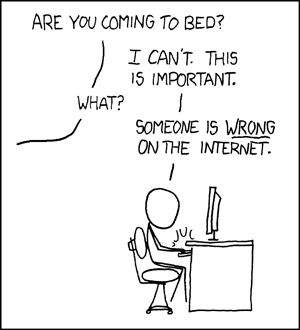
Basically, everybody who blogs about Diet & Nutrition is a nerd to some degree. If you're that obsessive about your diet that you've achieved success with it, you must be nerdly inclined. So here's a list (nerds love to make lists) of some nerdy bloggers. This is meant to be a bit of fun, so don't go all nerdy on me and shoot the messenger!
In no particular order, but ladies first:-
1) ItsTheWooo: I really like Wooo, because under that nerdy exterior lies a heart of gold. She out-nerds me by miles, though!
2) CarbSane: I deliberately put Evelyn next to Woo as that's about as close as these two are ever going to get! I like Evelyn because of her no-nonsense style.
3) Denise Minger: Denise cracks me up with some of the stuff she comes out with. She has an infectious giggle when she's lecturing. She also has the cojones to take on giants like T. Colon Campbell (oops!).
4) Kurt Harris MD: This chap really knows his stuff. I majorly pissed Kurt off last year by nerdily sticking-up for Aldi's "Solesta" EVOO (it only has 6.6% pufas!).
5) Richard Nikoley: This chap really knows his stuff (except for one topic ;-D). I majorly pissed Richard off recently by discussing politics with him. We have totally different views. I goaded Richard into calling me a "miserable, dishonest, lying f*ck of a wasted f*ck." We seem to be getting on better now. I mentioned politics once, but I think I got away with it!
6) Sean: An ex-engineer, so a top bloke. I goaded Sean into calling me a "hysterical c*nt". My bad!
7) Lyle McDonald: What Lyle doesn't know about Diet & Nutrition fits on a postage stamp. I've probably pissed him off as well!
8) LeonRover: Not a blogger, but he has proved invaluable in correcting expressions such as "Stone the flaming crows" and "No way, José".
Anyway, enough of all this silliness. It's time to visit mum.
Basically, everybody who blogs about Diet & Nutrition is a nerd to some degree. If you're that obsessive about your diet that you've achieved success with it, you must be nerdly inclined. So here's a list (nerds love to make lists) of some nerdy bloggers. This is meant to be a bit of fun, so don't go all nerdy on me and shoot the messenger!
In no particular order, but ladies first:-
1) ItsTheWooo: I really like Wooo, because under that nerdy exterior lies a heart of gold. She out-nerds me by miles, though!
2) CarbSane: I deliberately put Evelyn next to Woo as that's about as close as these two are ever going to get! I like Evelyn because of her no-nonsense style.
3) Denise Minger: Denise cracks me up with some of the stuff she comes out with. She has an infectious giggle when she's lecturing. She also has the cojones to take on giants like T. Colon Campbell (oops!).
4) Kurt Harris MD: This chap really knows his stuff. I majorly pissed Kurt off last year by nerdily sticking-up for Aldi's "Solesta" EVOO (it only has 6.6% pufas!).
5) Richard Nikoley: This chap really knows his stuff (except for one topic ;-D). I majorly pissed Richard off recently by discussing politics with him. We have totally different views. I goaded Richard into calling me a "miserable, dishonest, lying f*ck of a wasted f*ck." We seem to be getting on better now. I mentioned politics once, but I think I got away with it!
6) Sean: An ex-engineer, so a top bloke. I goaded Sean into calling me a "hysterical c*nt". My bad!
7) Lyle McDonald: What Lyle doesn't know about Diet & Nutrition fits on a postage stamp. I've probably pissed him off as well!
8) LeonRover: Not a blogger, but he has proved invaluable in correcting expressions such as "Stone the flaming crows" and "No way, José".
Anyway, enough of all this silliness. It's time to visit mum.
Sabtu, 03 Maret 2012
Exercise and Food Reward
Given all the current interest in the Food Reward theories of obesity (check out Richard's post with a phenomenal number of comments), I thought I'd just point to this study that popped across my screen this morning:
Aerobic exercise reduces neuronal responses in food reward brain regions
If Food Reward is an issue and I think it obviously is then we also need to think about exercise.
Aerobic exercise reduces neuronal responses in food reward brain regions
Exercise reduced neuronal responses in brain regions consistent with reduced pleasure of food, reduced incentive motivation to eat, and reduced anticipation and consumption of food. Reduced neuronal response in these food reward brain regions after exercise is in line with the paradigm that acute exercise suppresses subsequent energy intake.
If Food Reward is an issue and I think it obviously is then we also need to think about exercise.
UK: The Public Bodies, (Sustainable Food) Bill
From The Weston A Price Foundation London Chapter:

ACTION ALERT - Government moves to enforce their dietary guidelines upon schools, prisons, hospitals and all other public bodies. Please lobby your local MP and interest groups. Details below.
The Public Bodies, (Sustainable Food) Bill has just passed its second reading in the Houses of Commons.
This bill will force all public bodies, i.e. schools, prisons and hospitals to comply with the government's low fat, low salt, nutrient deficient dietary guidelines. This will bring Britain in-line with USA, where Federal Funding is dependent on compliance with the USDA's dietary guidelines which have caused so much harm. That drive is coinciding with corporations having their food certified as being one of your five a day. So we see baked beans and pizza being certified in order that they gain catering contracts if this legislation is passed.
PLEASE CIRCULATE MY RESPONSE TO THE BILL TO YOUR LOCAL MP AND INTEREST GROUPS: http://files.meetup.com/1463924/Sustainable%20Food%20Bill%20Response.doc
If this bill is passed, parents will only be able to provide nutrient dense foods if they provide a packed lunch and will be banned from lobbying their school to introduce nutrient dense foods. We have even seen in some American States, schools telling parents what to put in school lunches and Chicago has banned packed lunches to stop Parent's circumventing the dietary guidelines.
This bill is one step towards a tax on fat, saturated fat and sugar, which Prime Minister David Cameron has voiced support for this in the recent "Conservative" Party Conference. We are even against a tax on sugar because it will encourage artificial sweeteners.
Philip Ridley
01442 384451
westonaprice.london@gmail.com
westonaprice.org/london
Click Here to join our mailing list

ACTION ALERT - Government moves to enforce their dietary guidelines upon schools, prisons, hospitals and all other public bodies. Please lobby your local MP and interest groups. Details below.
The Public Bodies, (Sustainable Food) Bill has just passed its second reading in the Houses of Commons.
This bill will force all public bodies, i.e. schools, prisons and hospitals to comply with the government's low fat, low salt, nutrient deficient dietary guidelines. This will bring Britain in-line with USA, where Federal Funding is dependent on compliance with the USDA's dietary guidelines which have caused so much harm. That drive is coinciding with corporations having their food certified as being one of your five a day. So we see baked beans and pizza being certified in order that they gain catering contracts if this legislation is passed.
PLEASE CIRCULATE MY RESPONSE TO THE BILL TO YOUR LOCAL MP AND INTEREST GROUPS: http://files.meetup.com/1463924/Sustainable%20Food%20Bill%20Response.doc
If this bill is passed, parents will only be able to provide nutrient dense foods if they provide a packed lunch and will be banned from lobbying their school to introduce nutrient dense foods. We have even seen in some American States, schools telling parents what to put in school lunches and Chicago has banned packed lunches to stop Parent's circumventing the dietary guidelines.
This bill is one step towards a tax on fat, saturated fat and sugar, which Prime Minister David Cameron has voiced support for this in the recent "Conservative" Party Conference. We are even against a tax on sugar because it will encourage artificial sweeteners.
Philip Ridley
01442 384451
westonaprice.london@gmail.com
westonaprice.org/london
Click Here to join our mailing list
Gut Microbiome and metabolic health
This is another study that points to the the relevance of your gut microbes to health. The finding is that certain strains of microbe in the gut are associated with obesity-related Metabolic disorders.
Women With and Without Metabolic Disorder Differ in Their Gut Microbiota Composition
Women With and Without Metabolic Disorder Differ in Their Gut Microbiota Composition
Jumat, 02 Maret 2012
Warning signs to look out for when a heart attack is coming.
R.I.P. Davy Jones. I sang "Daydream Believer" at karaoke two nights running as a tribute.

The article Davy Jones Dead: Warning Signs to Look Out for When a Heart Attack is Coming caught my attention.
"At 66, Davy Jones appears to be living a healthy life. He was a vegetarian. He goes on a regular morning run. He was not just a horse owner but also a rider. Davy Jones seems to be generally fit and healthy to succumb to a deadly heart attack."
He's like H. Jay Dinshah, who also died of a heart attack at the age of 66. I strongly advise vegetarians & vegans to watch "Dr Greger: 2003 - Optimum Vegetarian Nutrition - Omega 3 and B12"
The article Davy Jones Dead: Warning Signs to Look Out for When a Heart Attack is Coming caught my attention.
"At 66, Davy Jones appears to be living a healthy life. He was a vegetarian. He goes on a regular morning run. He was not just a horse owner but also a rider. Davy Jones seems to be generally fit and healthy to succumb to a deadly heart attack."
He's like H. Jay Dinshah, who also died of a heart attack at the age of 66. I strongly advise vegetarians & vegans to watch "Dr Greger: 2003 - Optimum Vegetarian Nutrition - Omega 3 and B12"
sitting around and diabetes
I have had stuff up here before about the dangers of being too sedentary. Here is a new one about its link to diabetes
Diabetes Risk from Sitting Around
Diabetes Risk from Sitting Around
"This study provides important new evidence that higher levels of sitting time have a deleterious impact on insulin resistance and chronic low-grade inflammation in women but not men and that this effect is seen regardless of how much exercise is undertaken. This suggests that women who meet the national recommendations of 30 minutes of exercise a day may still be compromising their health if they are seated for the rest of the day.
Vitamin D and muscle
I am not even going to pretend that I have read this, but I spotted it earlier today and just wanted to get it out there
It is a review article on Vitamin D, but focussing on the way in which it impacts muscle and performance. The abstract is below and the whole thing is available as a pdf.
VITAMIN D AND ATHLETIC PERFORMANCE: THE POTENTIAL ROLE OF MUSCLE
CLINICAL RECOMMENDATIONS
It is a review article on Vitamin D, but focussing on the way in which it impacts muscle and performance. The abstract is below and the whole thing is available as a pdf.
VITAMIN D AND ATHLETIC PERFORMANCE: THE POTENTIAL ROLE OF MUSCLE
Vitamin D deficiency is a worldwide epidemic, with well known impacts on calcium metabolism and bone health, but increasingly recognized associations with chronic health problems such as bowel and colonic cancer, arthritis, diabetes and cardiovascular disease. In recent years in the Sports Medicine literature, there has been an increased focus on the potential impact that inadequate Vitamin D levels may have on athletic performance.
In the early 20th Century, athletes and coaches felt that ultraviolet rays had a positive impact on athletic performance, and while remaining limited, evidence is accumulating to support this view. Muscle structure and function is recognised to play a key role in athletic performance, and both cross-sectional and longitudinal studies allude to a functional role for Vitamin D in muscle. The identification of the Vitamin D receptor in muscle tissue provides a direct pathway for Vitamin D to impact upon Skeletal Muscle structure and function. This review focuses on the current understanding of the action of Vitamin D within skeletal muscle tissue, and the potential impact on performance.
CLINICAL RECOMMENDATIONS
• Athletes should have their (25-Hydroxy) Vitamin D levels measured regularly throughout the year.
• Vitamin D deficient or depleted Athletes should be advised on appropriate UVB exposure or supplemented as required.
• Optimal levels of Vitamin D remain controversial, but levels of 25-Hydroxy Vitamin D of 30ng/ml may be considered safe.
Change of title to:- Nige's Fashion & Lifestyle blog.
Today's topic of discussion:- Black leggings + tan Uggs. Fashion crime?

Gotcha!
What I know about Fashion & Lifestyle would fit on a postage stamp.
Have a good weekend.
P.S. I think that black leggings + tan Uggs are well hot.
P.P.S. I spoke to the nurse on Friday 2nd March about mum's medical history. Before Vitamin D3, mum had a Urinary Tract Infection in the previous 9 months. Since Vitamin D3, mum has had no medical problems and she has been happy & contented. Her serum Vitamin D level is in the normal range.
Gotcha!
What I know about Fashion & Lifestyle would fit on a postage stamp.
Have a good weekend.
P.S. I think that black leggings + tan Uggs are well hot.
P.P.S. I spoke to the nurse on Friday 2nd March about mum's medical history. Before Vitamin D3, mum had a Urinary Tract Infection in the previous 9 months. Since Vitamin D3, mum has had no medical problems and she has been happy & contented. Her serum Vitamin D level is in the normal range.
Kamis, 01 Maret 2012
Just take the exercise pill
Can we just make drugs which remove the need to exercise? Perhaps, but I hope not.
The abstract is here
"No one can deny that the human body was meant to move, and to move often," said Gerald Weissmann, M.D., Editor-in-Chief of the FASEB Journal, "but the reality is that many of us don't move enough, whether because of disease, injury, or simply a busy schedule. This discovery is another important step towards the treatment of muscle wasting in cancer, severe infection or aging – or to maintain our muscle mass to help face the slings and arrows of outrageous fortune."
The abstract is here
Marathons are dangerous?
Maybe. But maybe particularly if you are not used to running.
Post-Exercise Cardiac Troponin Release is Related to Exercise Training History
Post-Exercise Cardiac Troponin Release is Related to Exercise Training History
Average miles run per week in the last 3 years, a marker of total training experience, encompassing training volume and duration, was negatively associated with post-marathon cTnI release (p<0.001).
Langganan:
Komentar (Atom)